2025 in Space: Records, Rockets, and Milestones
2025 was another record-breaking year, with more than 300 successful launches, breakthrough missions, and major advances in new rockets. A recap of 2025 in space.

17 January 2026
|

9 minutes
|
2025, like the years before it, set a new record for orbital launch activity: 324 launches to Earth orbit, with a 96% success rate—311 successes and 13 failures. That is a striking increase over 2024, which saw 261 launches (a 97% success rate), and 2023, which ended with 223 launches (a 95% success rate).
More than half of the launches were carried out by SpaceX, and the vast majority used Falcon 9 rockets. The company flew 165 Falcon 9 missions during the year—just under one launch every two days. Most of those launches deployed Starlink satellites, the space-based internet network that now includes more than 8,000 active satellites. In almost all missions, Falcon 9’s first stage was reused, and some boosters have already logged more than 30 flights. Falcon 9’s record in 2025 was also remarkable: a 100% launch success rate.
SpaceX is now the world’s leading launch provider by a wide margin. Its launch total alone was almost double China’s combined commercial and government activity, which came to 91 launches. Even so, China’s figure reflects impressive progress compared with the 68 launches it conducted in 2024.
China also tried to narrow the gap with the United States in reusable launch technology, but without success so far. In December 2025, the Chinese company LandSpace successfully launched its Zhuque-3 rocket – often compared to Falcon 9 – but its first-stage landing attempt ended with the booster exploding above the landing site. Later that month, the state-owned conglomerate CASC launched its new heavy rocket, Long March 12A, on its maiden flight. The second stage reached orbit as planned, but the attempt to recover the first stage again ended in flames.
Excluding SpaceX, the United States conducted fewer than 30 orbital launches in 2025, about half of them by Rocket Lab, which operates in the United States but launches from New Zealand. Russia recorded 15 launches to Earth orbit. India ranked fourth with five launches, four of them successful; the most recent was on December 24, when an LVM3-M6 rocket carried into space the heaviest satellite ever launched from India to date: BlueBird 6, built for the U.S. company AST Mobile, which provides cellular communications and internet services from space, including technology developed at its R&D center in Israel.
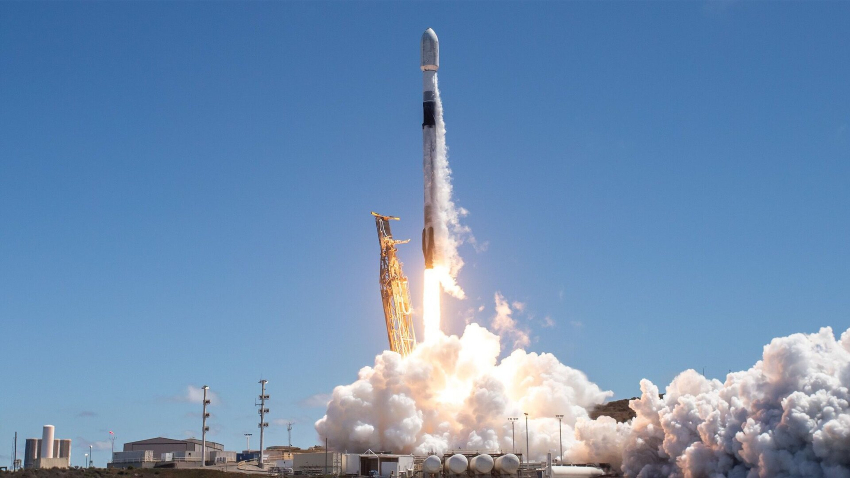
A launch almost every two days for the industry workhorse. A SpaceX Falcon 9 rocket lifts off from Vandenberg Space Force Base in California, July 2025 | Photo: SpaceX
Heavyweight Competition
Alongside its dominance in launches to Earth orbit, SpaceX continued to push ahead with development of its massive new launch system, Starship. The year began with setbacks in the seventh and eighth test flights, when the spacecraft exploded shortly after from the booster. The ninth flight also fell short, with the spacecraft entering a spin and burning up during atmospheric reentry. In August, however, the company achieved a successful test that met all objectives: it deployed dummy satellites in space and concluded with a landing maneuver over the sea. A similar test was completed successfully in October, wrapping up tests of Starship’s second version. In 2026, SpaceX is expected to begin testing a third version, which is slightly larger.
Blue Origin also advanced its heavy-lift rocket, New Glenn, which finally launched, after many years of development. On its first test in January, the upper stage reached orbit, but the first-stage landing attempt failed. In November, New Glenn was launched for the second time, and this time the first stage successfully landed on an ocean platform.
Success after a string of failures. Highlights of Starship’s tenth test flight:
The Race to the Moon Heats Up
SpaceX and Blue Origin are not only leading the development of heavy-lift rockets—they are also building the spacecraft meant to land humans on the Moon in the coming years. SpaceX’s Starship was selected as the crewed lunar lander for the first landing missions of the Artemis program, while Blue Origin’s lander is intended for later missions. However, NASA’s new administrator, Jared Isaacman, who recently took office, said he believes the competition should be opened up, with priority going to whichever company completes development first.
Officially, the United States aims to return astronauts to the Moon in 2027, following Artemis II in 2026—a crewed Orion mission that will fly around the Moon without landing. Given ongoing delays in lander development, however, that timeline appears highly ambitious.
China, meanwhile, is pursuing its own program to land astronauts on the Moon by the end of 2030. Over the summer it conducted a successful Earth-based test of its planned lander, Lanyue. The vehicle is smaller than the U.S. landers under development and is closer in concept to the Apollo-era designs. Still, China’s rapid progress has fueled concern in the United States that Chinese astronauts could return to the Moon before Americans do—one of the challenges now facing NASA’s new chief.
2025 also marked a milestone in private lunar exploration, with the first successful soft landing by a commercial spacecraft. In March, Firefly’s uncrewed Blue Ghost lander successfully touched down in the Sea of Crises. A few days later, another U.S. company, Intuitive Machines, also reached the lunar surface, but its IM-2 lander tipped onto its side on touchdown, limiting its performance—similar to what happened to the company’s first lander, IM-1, a year earlier. In June 2025, Japan’s iSpace attempted its own private lunar landing, but the spacecraft crashed, as its previous lander did in 2023.
Several uncrewed private lunar landings are planned for 2026, mainly by U.S. companies. China also intends to continue its lunar program: after Chang’e 6 returned the first soil samples from the Moon’s far side, the country plans to send Chang’e 7 to the south polar region, where scientists believe frozen water may exist in permanently shadowed crater soils. Over the longer term, both the United States and China aim to establish permanent lunar bases, and local ice could provide water, breathable oxygen, and rocket propellant—helping reduce the cost of sustaining operations under this ambitious effort.
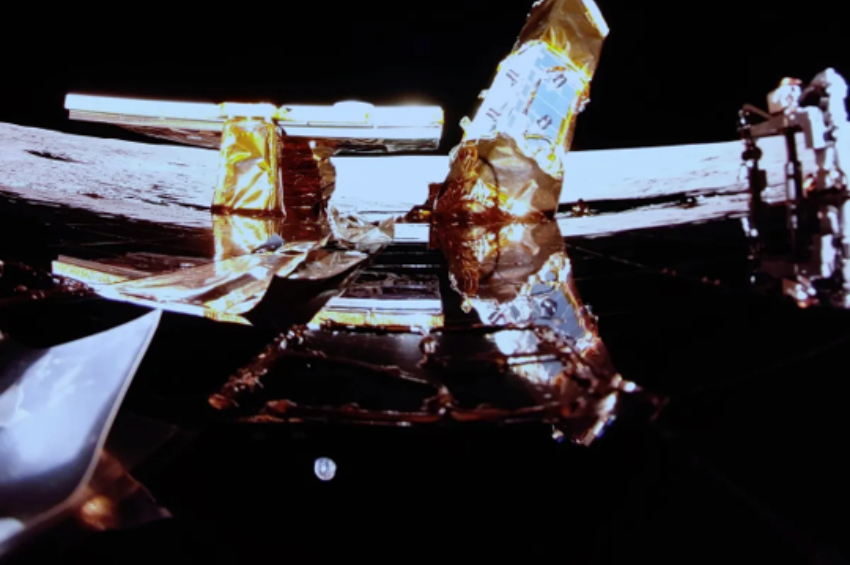
First soft landing by a commercial spacecraft. Firefly’s Blue Ghost lander shortly after touchdown on the Moon; Earth is reflected in its solar panel | Photo: Firefly
Space Stations: At The Dawn of a New Era
In November 2025, the International Space Station (ISS) marked a historic milestone: 25 years of continuous human presence in Earth orbit. Alongside this impressive achievement, the station has inevitably accumulated wear and tear, and it is expected to end operations by the end of the decade. Several U.S. companies are developing private space stations, and their first steps in orbit could come as early as 2026 – signaling the start of an era of commercial space outposts.
Despite growing maintenance challenges, activity on the ISS continues at full pace. This year, for the first time since the station was assembled, all eight of its docking ports were occupied at once by docked spacecraft. Some of the visiting vehicles were crewed spacecraft, which also serve as “lifeboats” for the station’s astronauts in an emergency, while others were uncrewed cargo ships.
China’s Tiangong space station—much newer than the ISS and continuously crewed for about four years—also faced challenges. A crack was discovered in a window of a spacecraft docked to the station shortly before a crew rotation. Mission managers decided to bring the departing crew back to Earth in the incoming crew’s spacecraft, temporarily leaving the three astronauts on the station without an escape vehicle in an emergency. The situation lasted only a few weeks, until China launched an uncrewed replacement spacecraft, but the incident underscored the importance of safety measures, and the ability to respond to hazards—even as space stations move toward private, commercial operation.
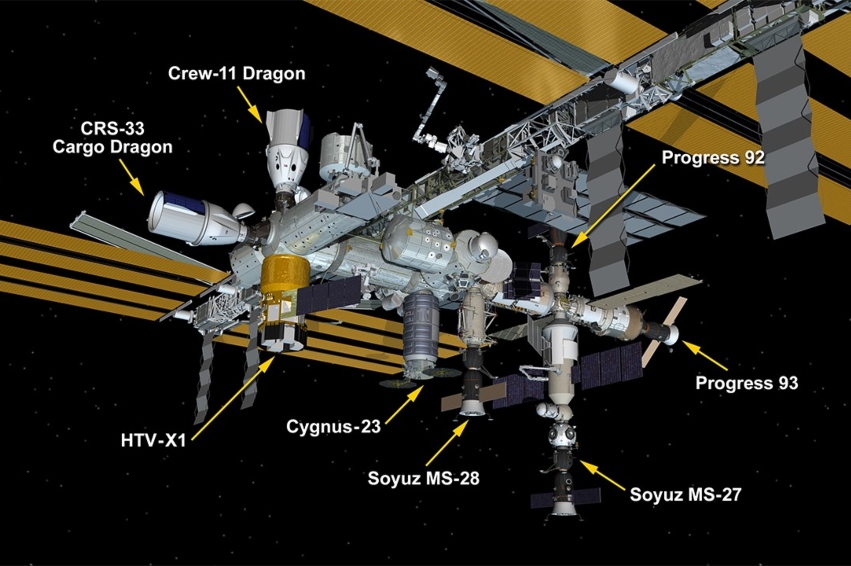
All berths occupied. The International Space Station with eight spacecraft docked to it | Source: NASA
Skies Full of Satellites
Over the past year, low Earth orbit has continued to fill with satellites at an accelerating pace. The main driver is SpaceX’s Starlink network, which marked the launch of its 10,000th satellite for the communications constellation. Each satellite is designed to operate for about five years, so some have already reached the end of their service life, and a few have been lost to malfunctions. The constellation is estimated to include more than 8,000 active satellites – about two-thirds of all active satellites orbiting Earth.
SpaceX announced that Starlink’s subscriber base more than doubled in 2025, reaching nine million, up from about four million in September 2024. The company plans to expand the network to 12,000 active satellites in the coming years, and ultimately to 42,000.
Starlink is the dominant satellite network, but it is far from the only one. China is developing two parallel satellite internet constellations. The Guowang network, run by the state corporation CASIC, currently has about 130 satellites—most launched during 2025—and is intended to grow to around 13,000, serving both civilian and military uses. In parallel, China has expanded the private communications constellation Qianfan, which currently numbers several dozen satellites and is also intended to reach roughly 15,000 in the future.
Starlink is the dominant satellite internet system, but it is far from the only one. The U.S. company Amazon is building its own communications network, Project Kuiper, and launched more than 120 satellites in 2025. Other companies pursuing large communications constellations also added satellites, though in smaller numbers.
About two-thirds of all active satellites in orbit today are Starlink satellites. Deployment from the second stage of a Falcon 9 rocket:
Private Space Missions
Private astronauts continued to push boundaries and blur the line between professional spaceflight and commercial missions in 2025. On the FRAM-2 mission, a privately funded crew flying aboard SpaceX’s Dragon spacecraft became the first humans to orbit Earth on a trajectory that passed over both poles. Meanwhile, Axiom Space’s fourth private mission to the International Space Station included, alongside veteran commander Peggy Whitson, three astronauts representing national space agencies from India, Poland, and Hungary, whose seats were purchased through the private company.
Blue Origin flew seven crewed tourist missions to the edge of space in 2025, up from three in 2024. The flights included the first all-women spaceflight, in which singer Katy Perry also participated. Among the 42 tourists who flew on the program was German engineer Michaela Benthaus, the first space tourist who uses a wheelchair.
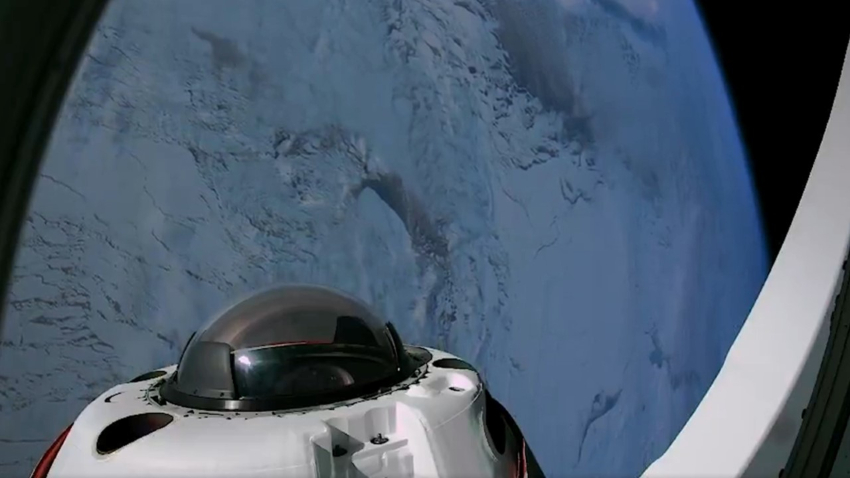
A view over the pole. The scenery from SpaceX’s Dragon spacecraft during the private FRAM-2 mission—the first time humans flew in an orbit passing over both poles | Photo: SpaceX
A Quiet Year on Mars
On the second launch of Blue Origin’s New Glenn rocket, the vehicle carried two small NASA satellites designed to study the Martian atmosphere. Because they were launched outside the optimal “launch window”—the period when Earth and Mars are relatively close and travel times are shorter—their route includes a longer cruise, and they are not expected to arrive at Mars until 2027.Toward the end of 2025, NASA lost contact with the MAVEN spacecraft, which has been studying Mars for more than a decade, and it appears to have reached the end of its mission.
NASA’s Perseverance rover identified iron- and phosphorus-rich minerals in Martian soil samples, a finding that may point to past conditions compatible with single-celled life in water that once covered parts of the planet. The findings drew considerable media attention, but they do not constitute solid evidence that life actually existed on Mars. The rover also documented auroras on the planet for the first time in 2025, helping scientists better understand processes in the Martian atmosphere.
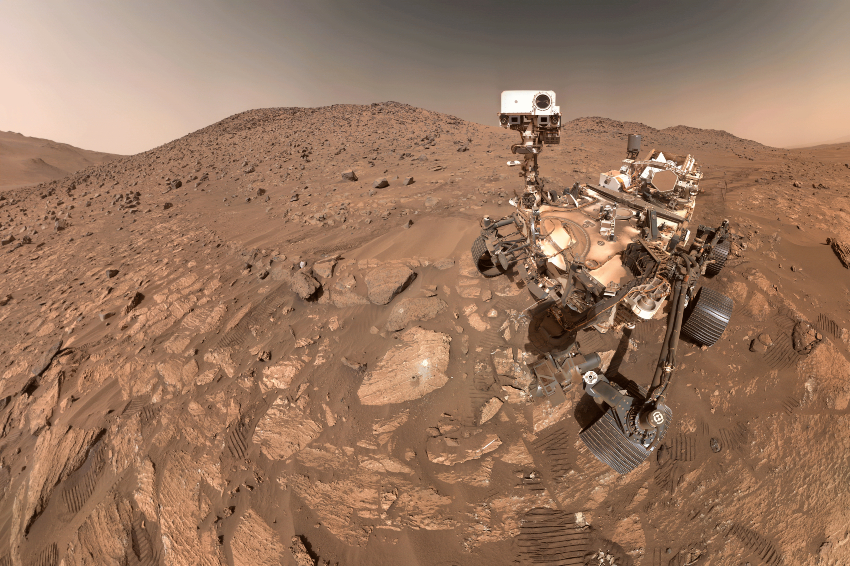
Still searching, but no definitive signs of life yet. NASA’s Perseverance rover on Mars | Source: NASA
A Comet From Another Star System
In early July, astronomers discovered an object that entered our neighborhood from beyond the Solar System. Designated 3I/ATLAS, it is only the third known interstellar visitor identified to date. It soon became clear that the object is an interstellar comet – one that, according to estimates, formed even before our Solar System. Claims that it is alien technology rather than a natural object have so far produced no supporting evidence. In December the comet reached the closest point to Earth along its trajectory. Although it is now rapidly receding, it is expected to take roughly another ten years to traverse the Solar System before continuing its journey among the stars.

A visitor from another solar system. The comet 3I/ATLAS in an image taken by the Hubble Space Telescope | Source: NASA, ESA, STScI, D. Jewitt (UCLA), M.-T. Hui (Shanghai Astronomical Observatory), J. DePasquale (STScI)