Retirement, a Landing, and a Solar Eruption: Space News Roundup
A veteran astronaut retires from NASA, a cracked spacecraft landed safely, a major military space-debris removal effort takes shape—and what’s the connection between solar eruptions and avalanches? Space News Roundup

25 January 2026
|

10 minutes
|
The Veteran Astronaut Retires
After 27 years at NASA and three long missions aboard the International Space Station, veteran astronaut Sunita (“Suni”) Williams has announced her retirement. Born in Ohio in 1965 to a father of Indian heritage and a mother of Slovenian heritage, Williams joined the U.S. Navy after high school. She earned a bachelor’s degree in physics from the U.S. Naval Academy, trained as a helicopter pilot, served multiple tours in the Middle East, and later became a test pilot. Over her career she logged more than 3,000 flight hours in more than 30 helicopter models. After completing a master’s degree in engineering, she was selected for NASA’s astronaut class in 1997.
Williams’ first space mission began in 2006. In September, she flew aboard Space Shuttle Discovery to the International Space Station, where she spent about nine months as part of Expeditions 14 and 15, returning to Earth on Shuttle Atlantis in June 2007. During that mission, Williams became the first person to run a marathon in space: she registered for the Boston Marathon and ran the full distance on a treadmill aboard the station alongside runners on Earth. She finished in 4 hours, 24 minutes, while the station traveled roughly 120,000 kilometers during her run.
Her second space mission followed in 2012. She flew to the ISS aboard a Russian Soyuz spacecraft and spent four months there as part of Expeditions 32 and 33. After the crew handover, she took command of the station, becoming only the second woman to hold the post (after fellow American Peggy Whitson). During the mission, Williams also made history as the first person to complete a “triathlon” in space—running on a treadmill, riding a stationary bike, and simulating swimming using weight-lifting resistance equipment.
In 2015, Williams joined NASA’s effort to develop commercially built spacecraft for carrying astronauts. She worked with Boeing on the development of the Starliner spacecraft, which faced major delays and did not reach a test flight until June 2024. NASA and Boeing ultimately went ahead with the launch despite helium leaks discovered in the spacecraft. Williams and her crewmate, Barry Wilmore, were expected to dock with the ISS, stay about eight days, and then return to Earth in Starliner. But after the leaks worsened on orbit, NASA repeatedly delayed the return and eventually reassigned Williams and Wilmore to a full-duration station mission as with Expeditions 71 and 72. They spent nine months aboard the ISS and returned to Earth in March 2025 on a SpaceX Dragon capsule, while Starliner later landed uncrewed—and intact.
Altogether, Williams logged 608 days in space. Over that time she carried out nine spacewalks—working outside the station in a spacesuit—for more than 62 hours in total. She also took on a wide range of roles at NASA, from leading an underwater team that studies extreme environments to helping develop training that prepares helicopter pilots to become astronauts who will one day land spacecraft on the Moon. “Anyone who knows me knows that space is my absolute favorite place to be,” Williams said in her retirement announcement. “It’s been an incredible honor to have served in the Astronaut Office and have had the opportunity to fly in space three times.”
Williams also holds a rare distinction: she has flown aboard four different spacecraft—the Space Shuttle, Soyuz, Starliner, and Dragon. She has not said what she plans to do after retiring, though some veteran astronauts, including Whitson, continued flying after leaving NASA by joining private space companies.
“Suni Williams has been a trailblazer in human spaceflight, shaping the future of exploration through her leadership aboard the space station and paving the way for commercial missions to low Earth orbit,” said NASA Administrator Jared Isaacman. “Her extraordinary achievements will continue to inspire generations to dream big and push the boundaries of what’s possible.”
Not just a marathon: In a video tour of the space station, Sunita Williams demonstrates how you sleep, wash your hair, and even use the bathroom in space.
The Upside of a Medical Evacuation
Four astronauts returned to Earth recently after their mission aboard the International Space Station was cut short due to a medical emergency involving one of the crew. The team—Americans Zena Cardman and Michael Fincke, Japanese astronaut Kimiya Yui, and Russian cosmonaut Oleg Platonov—spoke about the experience at a press conference last Wednesday in Houston. They did not identify which astronaut required treatment or share medical details, but Fincke offered a hint, noting that the station’s ultrasound equipment proved especially useful. “In the future, I recommend having portable ultrasound devices on every space mission,” he said. “It really helped.”
The Japanese astronaut, Kimiya Yui, said at the press conference that the incident was actually a positive one. “This is actually a very, very good experience for the future of human spaceflight,” Yui said. The event showed that the astronauts and the mission control team “can handle any kind of difficult situation.”
The station is now staffed by a three-person crew—two Russians and one American—who will focus on routine maintenance until the next crew arrives aboard an American Dragon spacecraft next month.
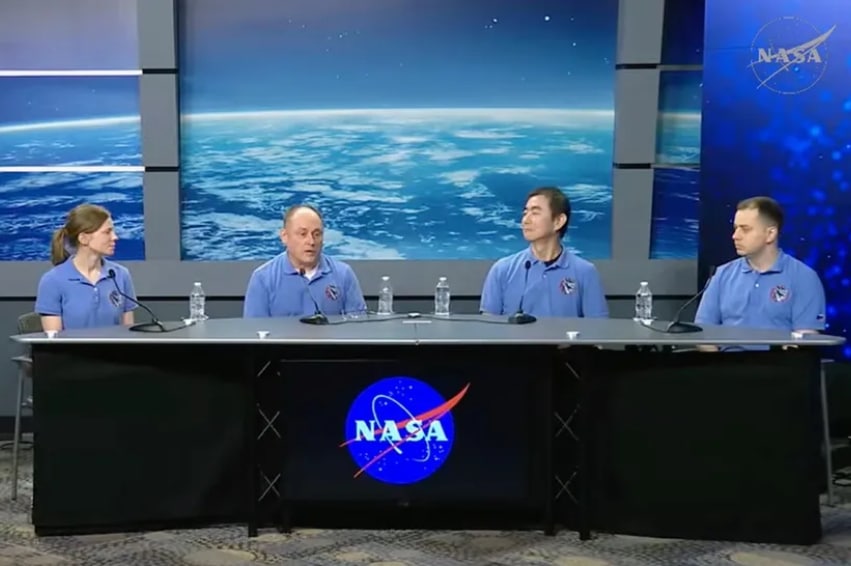
Everyone looks healthy now. From right to left: Platonov, Yui, Fincke, and Cardman at NASA’s press conference this week | Photo: NASA TV
A Cracked Spacecraft Landed Successfully
China’s Shenzhou 20 spacecraft returned to Earth last week, uncrewed, after a crack was discovered in one of its windows—apparently caused by an impact from space debris.
Shenzhou 20 launched to China’s space station in April 2025 carrying three astronauts. The crew was scheduled to return to Earth in early November, following a brief handover with the replacement mission, Shenzhou 21. But during routine pre-departure checks, engineers detected a crack in a window, and the China Manned Space Agency opted not to take any chances. The Shenzhou 20 crew returned to Earth aboard Shenzhou 21, leaving the station’s occupants without a dedicated “lifeboat” for about ten days – until China launched the next spacecraft, Shenzhou 22, to the station uncrewed. The astronauts currently aboard the station are expected to return to Earth in that vehicle when the time comes.
Meanwhile, the damaged spacecraft remained docked to the station. A few weeks ago, astronauts conducted a spacewalk to photograph the crack at close range and in high resolution, allowing engineering teams to analyze it in detail. The crew also applied a special repair kit—delivered with Shenzhou 22—designed for exactly this kind of situation.
This week China decided to bring the cracked capsule home. It undocked from the station on Monday and, a few hours later, touched down safely at its designated landing site in northern China. An initial inspection found that the equipment inside was not damaged. The agency declared the recovery a success, saying that “With the return of the Shenzhou-20 spaceship, all main tasks of the space emergency response for China’s space station have been successfully completed.”
Chinese teams are expected to continue investigating the incident to reduce the risk of similar damage in the future—and potentially to develop additional repair techniques. Beyond the crack itself, the episode also demonstrated that China’s spacecraft can remain fully functional after nine months docked to a space station—useful information in its own right.
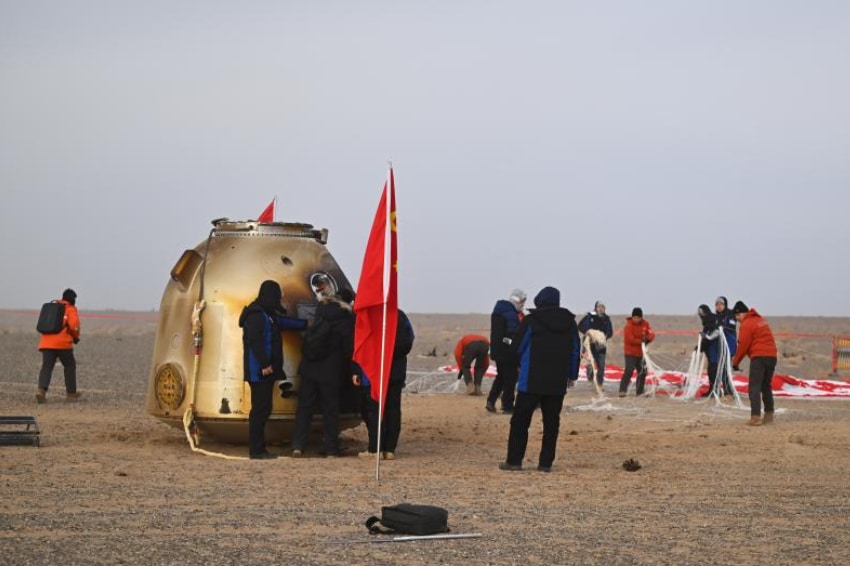
Landed safely despite the cracked window. The Shenzhou 20 spacecraft after landing in Inner Mongolia in northern China. Photo: Xinhua / Li Zhipeng
Removing Military Debris
The U.S. company Starfish Space has won a U.S. Space Force contract worth more than $50 million to remove retired military satellites from low Earth orbit.
The company is expected to fly its first debris-removal mission as early as 2027. In that demonstration, a Starfish satellite would rendezvous with and attach to a satellite in the PWSA (Proliferated Warfighter Space Architecture) constellation—a growing satellite network that supports communications, intelligence, air defense, navigation, and other missions—then guide it onto a controlled path for safe burn-up during atmospheric reentry. If all goes well, the same vehicle could repeat the process with additional satellites.
PWSA is still under construction and is ultimately expected to number in the hundreds, with satellites designed to communicate with one another. Traditionally, most militaries have spent heavily on a relatively small number of high-end spacecraft for intelligence, military communications, early warning, and similar missions. The Space Force’s newer approach spreads those capabilities across larger constellations of cheaper satellites, boosting redundancy and flexibility. The downside is that smaller satellites typically have shorter lifespans; with hundreds in orbit, failures become more likely—and so does the risk of adding to the space-debris problem.
Services like Starfish’s are meant to make these constellations more sustainable: operators can keep satellites working as long as they remain healthy, without committing to a fixed retirement date, with the option to remove them promptly once performance drops—whether that happens earlier or later than planned.
Starfish received a $52.5 million Space Force award to fund the demonstration using its Otter spacecraft. Founded in 2019, the company has yet to fly a full-scale Otter vehicle, but it has made steady progress with smaller technology demonstrators. In 2023 it launched its first demo satellite, Otter Pup, on a SpaceX rideshare mission; the craft closed to within about a kilometer of a target satellite and photographed it. A separate company has since demonstrated similar proximity operations using Starfish’s software.
In June 2025, Starfish launched another demo satellite, Otter Pup 2, which is expected to attempt a physical docking with a target satellite in low Earth orbit in the coming months. The company also plans to launch its first full Otter spacecraft later this year to validate the system’s capabilities, with an initial operational deorbit demonstration targeted for next year.
Several companies worldwide are developing similar rendezvous-and-docking technology—either to remove derelict satellites and other space debris, or to extend the lives of large, expensive spacecraft through orbit-raising maneuvers, repairs, or in-space refueling. One of the best-known players in this field is Astroscale, a U.S.–Japanese-owned company with a development center in Israel that has won similar contracts from the Japanese government.
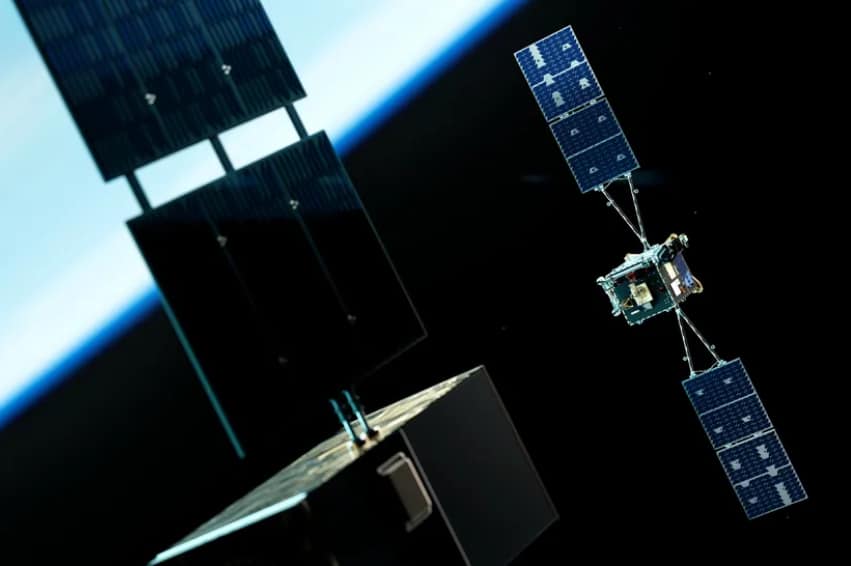
Designed to help large satellite constellations operate efficiently without adding to the debris problem: an Otter satellite approaches a target in low Earth orbit | Illustration: Starfish Space
Magnetic Avalanche
The Sun remains in a particularly active phase, and last Monday a new wave of particles from a powerful solar storm struck Earth—one rated at the highest level: Level 4. The storm sparked auroras far beyond the polar regions, with sightings reported in Germany and even as far south as the U.S. state of New Mexico. Such storms are often driven by a sudden eruption of vast amounts of plasma from the outermost layer of the solar atmosphere – the Sun’s corona, a phenomenon known as a coronal mass ejection (CME).

Thanks to heightened solar activity, auroras have been appearing far from the poles as well—like this display over a lake in Finland last week | Photo: Tanel1, Shutterstock
Meanwhile, a new study sheds light on how a related—but distinct—phenomenon forms: solar flares, rapid and powerful bursts of energy released from the Sun’s surface. Flares and coronal mass ejections (CMEs) sometimes occur together, and for both there is still much we don’t know—gaps researchers are trying to fill with spacecraft dedicated to studying the Sun. Analyzing observations from the European Solar Orbiter, scientists found that flares can behave much like snow avalanches: they may begin with tiny shifts in the Sun’s magnetic field lines, then rapidly cascade into a runaway process that ends in a sudden, enormous release of energy.
The European spacecraft has been orbiting the Sun since 2020 on an elliptical path that periodically brings it relatively close—about 42 million kilometers away (a little more than a quarter of Earth’s distance from the Sun). During one such pass in September 2024, the spacecraft captured a solar flare with several instruments, including an ultraviolet imager and sensors that measure temperature, magnetic fields, and other conditions. For roughly 40 minutes, Solar Orbiter recorded images and data every two seconds, giving researchers an unusually detailed view of how the event unfolded. In a paper published last week in Astronomy & Astrophysics, the team describes the step-by-step buildup and reports that small shifts in magnetic field lines set off a chain reaction: instability in the region rose rapidly, field lines snapped and reconnected, and the process culminated in an energetic outburst that sent a surge of X-ray radiation into space. “We didn’t expect that the avalanche process could lead to such high energy particles,” said the study’s lead author, Pradeep Chitta, of the Max Planck Institute for Solar System Research, Göttingen, Germany. “We still have a lot to explore in this process, but that would need even higher resolution X-ray imagery from future missions to really disentangle.”
It begins with subtle changes, then quickly escalates into an eruption that blasts energetic radiation into space. Solar Orbiter’s footage of a solar flare, in a video from the European Space Agency (ESA):