The Private Space Station Race and a ‘Reversed’ Planetary System: This Week in Space
Another company has been approved for a private mission to the space station, astronauts are bringing smartphones, and a rule-breaking planetary system is turning expectations upside down. This Week in Space.

23 February 2026
|

9 minutes
|
The Race for the First Private Space Station Heats Up
Several companies are leading the race to build the first commercial space station in orbit around Earth, and competition is now intensifying over what has emerged as a key funding channel for such ventures: private-astronaut flights to the International Space Station (ISS).
Axiom Space, which won a NASA contract to build a private space station using the ISS as a base, has so far flown four private-astronaut missions. Last month, the company received approval for another private mission to the station. But about a week ago, its exclusivity ended when NASA approved another aspiring private-station developer – Vast – to launch a private-astronaut mission to the ISS.
This will be the sixth private-astronaut mission to the ISS. Officially, these flights are meant to build experience ahead of private-station operations. “Leveraging the remaining life of the International Space Station with science and research-led commercial crewed missions is a critical part of the transition to commercial space stations and fully unlocking the orbital economy,” said Vast CEO Max Haot. In practice, Axiom’s missions are also a major source of revenue. Each flight includes a commander—an experienced astronaut employed by the company – and three passengers, each paying at least $50 million. On the first mission, the customers were private individuals. On later missions, a growing share of seats has gone to astronauts from national space agencies that are not active ISS partners – such as India, Hungary, and Turkey – whose governments paid for the flights. While these missions have demonstrated privately flown crews conducting research in orbit, it remains unclear how much their results will influence the design, planning, or operation of future commercial stations. Vast aims to launch its first station around 2028, and its crewed mission to the ISS is not expected before the summer of 2027 – by which time the station’s design and manufacturing will likely be in their final stages.
Opening competition for private missions to the ISS marks another step in the race toward the first commercial station. Still, beyond the historical milestone, it may matter less which company gets there first. Over the next decade, several private stations will likely operate in orbit around Earth, each with its own strengths, drawbacks, and market niche. One company almost certain to benefit is SpaceX. While it is not currently developing its own space station, it remains—at least for now—the only provider regularly launching humans into space. All Axiom missions to date have flown on SpaceX’s Dragon spacecraft, and that pattern will likely continue with Vast, which also plans to launch its station on a SpaceX rocket.
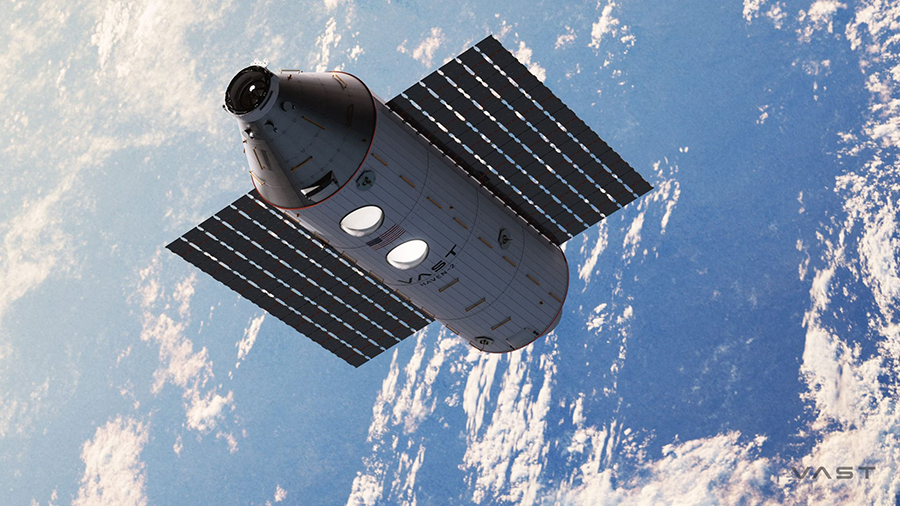
In the coming decade, Earth orbit will likely host several private stations. An illustration of Vast’s Heaven-1 station, designed for two-week missions with four astronauts | Source: Vast
Candy Crush in Space
A new crew arrived at ISS last weekend, and this time they brought something new alongside the standard gear: NASA has approved astronauts to take smartphones into space—devices that on Earth are an inseparable part of everyday life for most of us.
The main goal is to make it easier for astronauts to take – and share – more photos. Announcing the change on X, NASA Administrator Jared Isaacman wrote on “We are giving our crews the tools to capture special moments for their families and share inspiring images and video with the world.” He added that “just as important”, NASA “challenged long-standing processes and qualified modern hardware for spaceflight on an expedited timeline,” arguing that this operational urgency will support the agency’s push for high-value science and research in orbit and on the lunar surface. “This is a small step in the right direction,” he concluded.
Isaacman himself flew on two privately funded missions before being appointed NASA administrator, and he took a phone to space on the Polaris Dawn mission.
The ISS already has several highly advanced cameras, but they aren’t always within reach. A smartphone makes it easy to grab a quick shot of a striking view outside, document experiments, or capture everyday life on board. With wireless internet now available on the station, astronauts can also send photos and videos to Earth more easily.
The new policy won’t be limited to the ISS. The crew of Artemis 2—the first crewed lunar flyby mission of the 21st century – will also carry smartphones. They won’t have Wi-Fi, so any photos and videos will have to wait until the crew returns to Earth. And with only limited downtime, some of it may go to games rather than to taking in the views of space and the Moon. Either way, it will mark the first time smartphones – and the culture that comes with them – reach the lunar neighbourhood, and eventually, likely the Moon itself.
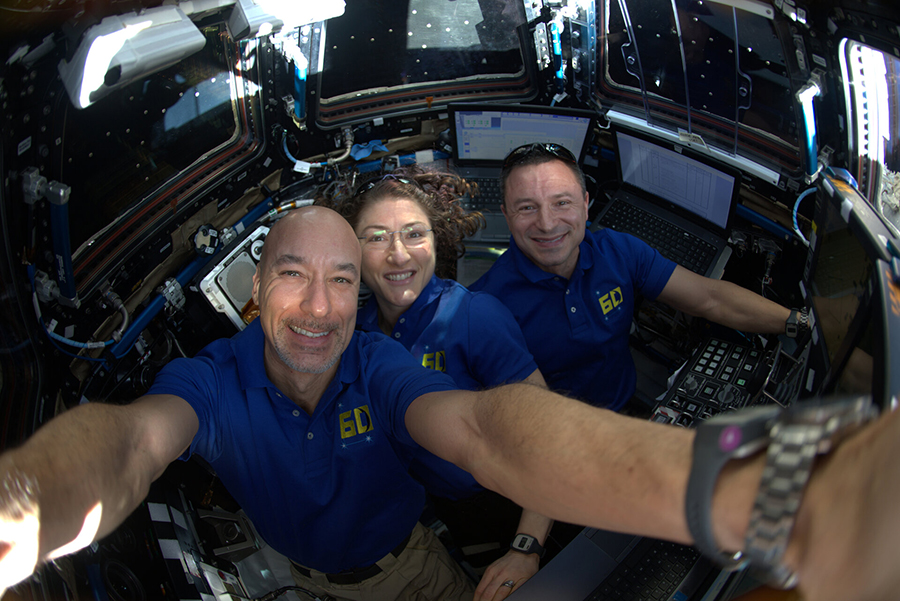
Selfies in space are about to get much easier. Italian astronaut Luca Parmitano in a self-portrait with his American colleagues Christina Koch and Andrew Morgan | Source: ESA/NASA
Building a Space Ecosystem in Israel
Israel has a number of space companies, “but the number of startups that have succeeded here in the space field can be counted on the fingers of one hand,” says space engineer and entrepreneur Dr. Raz Itzhaki. “I argue that you can’t do space unless you treat it as an ecosystem. You can’t have only entrepreneurship, only fundraising, only consulting, or only education – you need all of it together. That’s why I founded Orbit Catapult, to help entrepreneurs and space startups avoid the mistakes I’ve already made, and benefit from the good decisions I did make.”
A long-standing and well-known figure in Israel’s space community, Itzhaki began his career at MAFAT, the R&D Directorate of the Ministry of Defense. He later founded and led the small-satellites division at Israel Aerospace Industries, then moved into the private sector, where he founded the satellite communications company NSL and other ventures. A few years ago, he began setting up the Orbit Catapult investment fund, but in October 2023 the Swords of Iron War broke out, and since then he has spent more than 700 days in reserve duty. “About half a year ago the space bug started itching again. We submitted a proposal to establish the National Center for Space Accessibility, and even though we didn’t win, we kept going—building Orbit as a company whose goal is to create a private-sector space ecosystem,” Iitzhaki said.
Orbit’s main clients are entrepreneurs looking to enter the space sector and early-stage startups. “We assess how well a project fits the space domain, test its feasibility, estimate development timelines, identify the most relevant markets, and connect the company with the right investors.” At the same time, Yitzhaki leads several space ventures he has founded or joined, and he teaches courses for managers and entrepreneurs in the space sector.
“Many space initiatives fail in the ‘Valley of Death’—the gap between early support for an idea and raising the significant capital needed to execute it – because development takes so long, costs are high, and risks are substantial. Our goal is to reduce that failure rate,” Itzhaki said. “A lot of entrepreneurs fall in love with space, and my job is to connect that love to the ground of reality.”
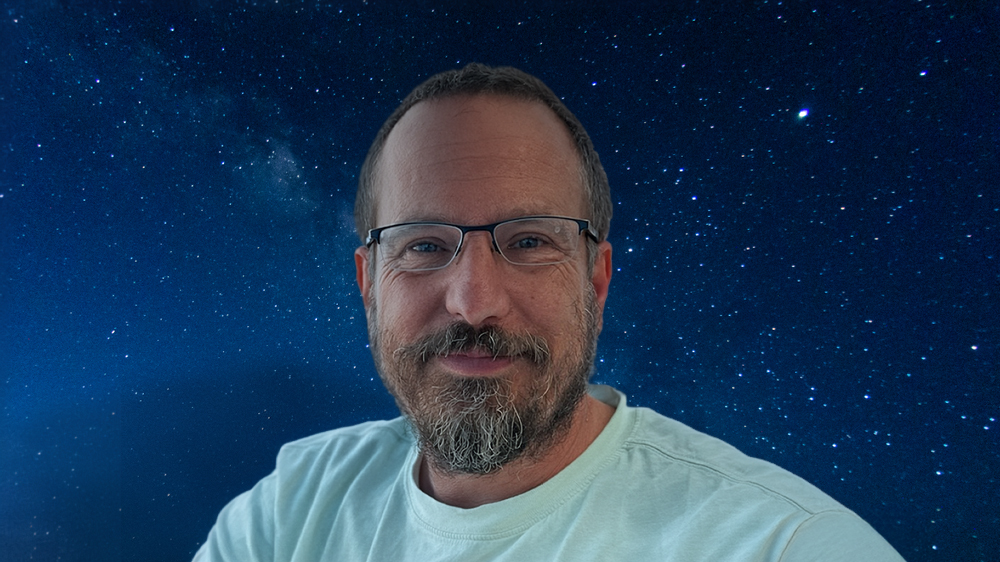
Helping space startups cross the “valley of death” and reach significant funding. Raz Itzhaki | Photo courtesy of Raz Itzhaki
A ‘Reversed’ Solar System
Planetary systems usually follow a familiar pattern: rocky planets orbit close to their star, while gas giants lie farther out. Our own solar system is a textbook example—four rocky worlds (Mercury, Venus, Earth, and Mars) followed by four gas giants (Jupiter, Saturn, Uranus, and Neptune). The last two, farthest from the Sun, are “ice giants,” rich in heavier volatile compounds. The same general order has appeared in other multi-planet systems we’ve studied – until now. Researchers in Switzerland, using the European space telescope CHEOPS, have identified an “inverted” system in which a rocky planet circles on a wide, outer orbit, farther from its star than neighboring gaseous planets.
The star LHS 1903 is a red dwarf – smaller and cooler than the Sun – located about 116 light-years away. Earlier observations by NASA’s TESS mission revealed three planets: one relatively close to the star that, based on its mass, is likely rocky, and two farther out that are most likely gaseous. In a new paper, the team reports the discovery of a fourth planet that breaks this expected pattern. “Since rocky planets do not usually form beyond gas giants, this one completely overturns our theories!” said Associate Professor Monika Lendl of the University of Geneva.
Stars typically form when a swirling cloud of gas and dust collapses under its own gravity. As the material compresses, pressure and temperature rise until the newborn star ignites and begins emitting radiation. Planets form from the leftover material in the disk surrounding that young star, so the planets in a given system are typically of similar age. Close to the star, heat makes it difficult for planets – even those with a solid core – to accumulate and retain large amounts of gas, favoring rocky worlds with thin atmospheres. Farther out, in colder regions, gas can more easily collect around growing cores, producing gas-rich planets.
The researchers used computer simulations to test scenarios that could produce the “inverted” arrangement—for example, a collision that triggered a powerful blast, stripping the system’s fourth planet of its gas and leaving only a solid core. Another possibility was a planetary collision that shifted the system’s planets out of their original orbits. In the end, they favored a different explanation: the odd planet out may simply be much younger than its siblings. “Based on computer simulations we have developed for decades at the University of Bern, we showed that the outer planet, LHS 1903 e, formed at a much later stage than the two nearby gas giants,” said Prof. Yann Alibert from the research team. “The fourth planet, whose mass is similar to the third, would also be expected to retain a significant gaseous envelope. Our hypothesis is that it formed after the gas had already disappeared from the planet-forming disk—after the system’s two gas giants had formed.”
In the end, they favored a different explanation: the odd planet out may simply be much younger than its siblings. “Based on the planetary formation simulations we’ve been developing at the University of Bern for several decades, we were able to show that LHS 1903 e must have formed much later than its two gas giant siblings,” explained Prof. Yann Alibert of the University of Bern, co-author of the study, “Indeed, the fourth planet – with a mass equivalent to that of the third, which contains a massive envelope of gas – should have accumulated and retained a large amount of gas. Our hypothesis is therefore that it formed after the gas disappeared from the protoplanetary disk, and thus after the second and third planets of the system, which are gas giants.”
According to the researchers, CHEOPS’s high-precision measurements made it possible to identify this system’s unusual architecture. As technology advances, they expect more planetary systems to turn up that challenge the notion of our solar system as a universal template—and help clarify how it fits into the broader picture.
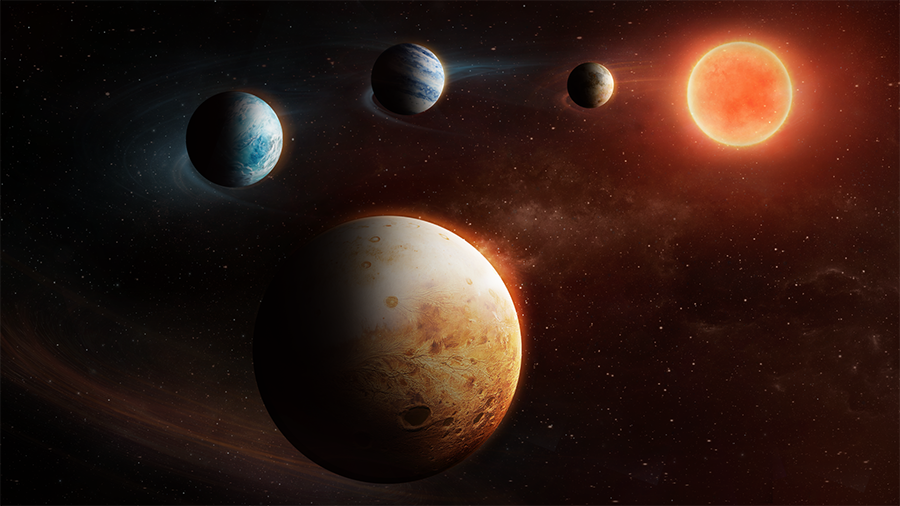
An artist’s depiction of the LHS 1903 system: the red-dwarf star on the right; to its left, the three previously discovered planets, including two gas giants; and in the foreground, the newly identified fourth planet, a rocky world | Illustration: ESA