Skating on Ice: A Physics Mystery
Sometimes physics struggles to provide clear answers to questions that seem simple. One of these questions is why ice is slippery. Although humans have been slipping on ice for many years, scientists still haven’t agreed on a single theory that fully explains why. A new study offers a potential answer.
On February 6, 2026, the Winter Olympic Games opened in Milan and Cortina d’Ampezzo, Italy. Athletes from around the world are competing in various disciplines, including skiing, skating, and more. The oldest of these sports is figure skating, which was first recognized as an official event at the Olympic Games in London in 1908. It was also the first to be included in the Winter Olympics when they were first held in 1924 in Chamonix, France. In this discipline, participants skate on ice at speeds of up to 25 kilometers per hour, performing intricate routines that emphasize both technique and aesthetics. Over the years, additional skating disciplines have been introduced, including speed skating, where competitors reach speeds of more than 50 km/h, and luge races, which involve thin metal blades and can reach speeds exceeding 100 km/h.
The act of skating on ice may seem straightforward, and many of us have likely tried it ourselves. However, the physical mechanisms behind ice skating are more complex than they appear, and some of them remain a subject of debate among physicists to this day. So, why is ice so slippery, and how do skates enable such high speeds?
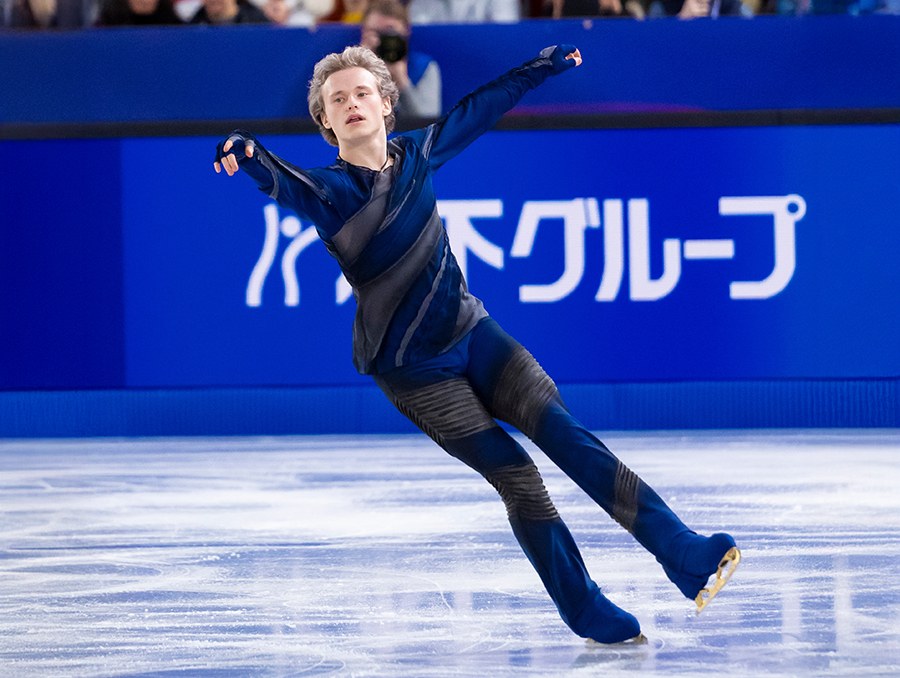
What is it about the combination of the ice surface and the design of the skates that enables such high speeds? The mechanisms are likely more complex than we might realize. World champion figure skater Ilia Malinin in action at a competition in Grenoble | Photo: EUPA-IMAGES, Shutterstock.
Pressure Melting
The oldest and most well-known theory dates back to the 19th century with the development of thermodynamics, the theory of heat. As we know, water can exist in three different states: solid (ice), liquid (water), and gas (vapor). From our daily experiences, we know that when we change the temperature of water, we can change its state. When water reaches 0°C, it freezes and turns into ice. However, water has a unique and nearly exclusive property in nature known as the anomaly of water: unlike most substances, which solidify under pressure, water behaves in the opposite way. Under high pressure, water’s melting point decreases, meaning ice can melt at lower temperatures. AAccording to the pressure-melting (pressure-induced melting) theory of sliding on ice, the pressure exerted by a skate blade lowers the melting point at the ice–blade interface, causing a thin film of water to form that acts as a lubricant and makes the sliding motion possible. Pressure is the force exerted per unit area—the same force applied over a smaller area produces higher pressure. That’s why skate blades are so thin: they concentrate a skater’s weight onto a narrow strip of ice, increasing the local pressure and promoting melting at the interface.
The problem with this theory is that the colder the ice, the greater the pressure required to turn it into water. At 20°C below zero, the pressure needed for sliding would be far higher than a person’s body weight could produce. If the theory were correct, skating on an especially cold winter day would require blades so thin as to be absurd. Another issue is that such extreme pressure isn’t actually necessary to sense ice’s slipperiness. Michael Faraday demonstrated this as early as the 19th century when he showed that two adjacent ice cubes stick together almost without applying any force, indicating that a liquid layer forms on their surfaces.
Additional Theories
Following this experiment, Faraday proposed an alternative idea: that even before ice begins to actively melt, an extremely thin, naturally occurring, liquid-like layer forms on its surface. In this view, the ice surface is inherently unstable, and molecules in the outermost layer vibrate and behave more like a liquid—even at very low temperatures. The difficulty is that, if a universal slippery layer were the whole story, we would expect different materials to slide on ice in roughly the same way. For example, when oil is spilled on a road, a rubber tire and a metal rim both slip for essentially the same reason. But on ice, different materials can behave very differently. In other words, it doesn’t fully explain why ice behaves so differently under different materials. During Faraday’s lifetime (he died in 1867), there was no way to test this idea directly, but it has gained renewed attention in recent years as microscopic examination of ice has become possible.
Another theory, proposed in the late 1930s, attributed sliding to frictional heating as a body moves across the ice. Whenever an object slides over a surface, the friction between them converts some of the energy of motion into heat. In this view, that heat melts the ice, creating a thin film of water that lubricates the motion. However, researchers who measured the ice temperature while an object slid across it at a set speed—at about 7°C below zero—did not observe the ice warming to 0°C. This suggests that sliding can occur even without melting the ice into liquid water.
It seems that several explanations have been proposed for why ice is slippery, but each of them breaks down under certain conditions. As a rule of thumb in science, when there are too many competing explanations for the same phenomenon, it’s a sign that at least some of them are incomplete—or simply wrong.
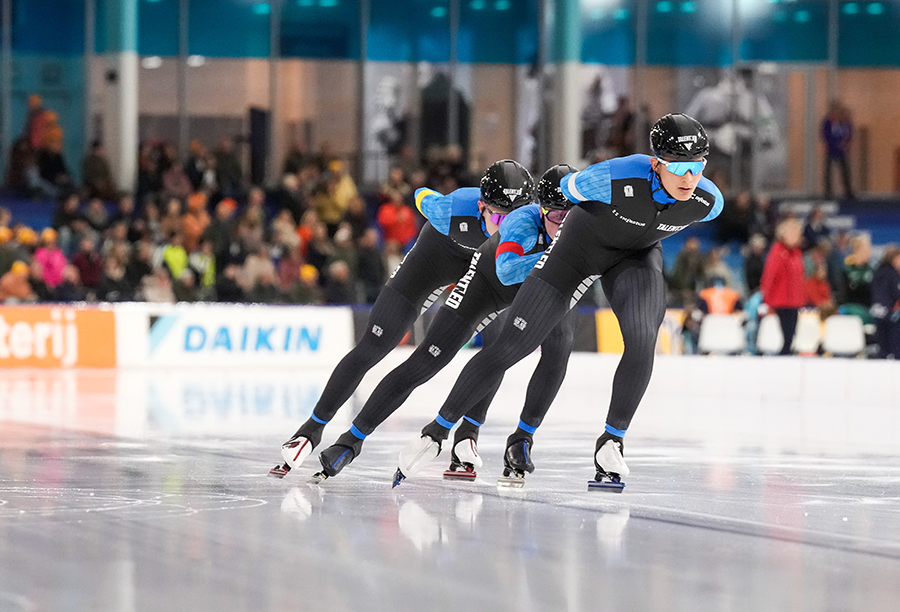
Simple explanations that rely on heat or pressure causing partial melting may seem convincing at first, but they don’t fully account for the phenomenon. A speed skating competition in the Netherlands | Photo: Orange Pictures, Shutterstock.
Ripping Molecules Free
A recent study by a group of researchers at Saarland University in Germany offers a new angle on the problem. The theory draws inspiration from a similar phenomenon observed in silicon and diamond. Like any crystal, ice is built from molecules arranged in a repeating, orderly pattern. Its basic building block—the water molecule—consists of one oxygen atom bonded to two hydrogen atoms. Because the oxygen nucleus is larger than the hydrogen nuclei, the water molecule’s electrons spend more time near the oxygen. The result is an electric dipole: one side is slightly more negative and the other slightly more positive. The molecule is electrically neutral overall, but its charge is distributed unevenly.
When ice comes into contact with another surface—such as a skate blade—the static electric field that builds up at the interface between the surfaces exerts forces on the dipoles of nearby water molecules. As the blade moves relative to the ice, the electric field pulls on one side of each molecule and pushes on the other, effectively dislodging molecules from their fixed positions in the crystal. The result is a thin, amorphous layer of water molecules—not quite liquid and not quite solid, but a material whose viscosity can vary. This layer acts as a lubricant, allowing the blade to glide.
To test the theory, the researchers ran computer simulations of how ice’s molecular structure behaves at different temperatures. The simulations could vary the properties of the surface in contact with the ice—its shape (flat or curved), the speed at which it moves, and its hydrophobicity, or how strongly it attracts water molecules. The results suggested that the fastest sliding occurs on a surface that is both smooth and hydrophobic. A skate’s smooth metal blade matches those conditions particularly well.
Another surprising conclusion of the study is that this sliding mechanism can operate at extremely low temperatures—even close to absolute zero—because it does not rely on generating heat to melt the ice. However, under such frigid conditions, sliding becomes less effective, as the lubricating layer grows too viscous to allow smooth motion.
As always in physics, simulations are only a first step, and the idea will ultimately have to be tested in real-world experiments. When American skater Ilia Malinin—the reigning world champion—takes the ice, he likely gives little thought to the molecular details that make his spectacular routines possible. And perhaps there’s still something enchanting about the fact that such a beautiful, familiar phenomenon remains only partly understood.
As always in physics, simulations are only a first step, and the idea will ultimately have to be tested in real-world experiments. When American figure skater Ilia Malinin – the reigning world champion – takes to the ice, he’s probably not thinking about the hidden physics that makes his spectacular routines possible. And perhaps there’s still a kind of magic in the fact that such a beautiful, familiar phenomenon has yet to be fully explained.




 11 February 2026
  6 minutes


