Microgravity Labs, Space Partnership, and Atmosphere Search: This Week in Space
Impressive achievements for SpacePharma, a long-term agreement with NASA, astronauts returning safely, and the search for an atmosphere in a nearby solar system. This Week in Space

17 December 2025
|

7 minutes
|
Israeli Biology in Microgravity
A project involving the Israeli company SpacePharma has been selected as one of just two initiatives to join the European Space Agency’s (ESA) Life Sciences Accelerator program. Led by the French startup Medetia, the project will examine how microgravity affects the development and function of cartilage cells. The research will focus on primary cilia—cellular structures essential for cartilage health—and investigate how they respond to mechanical stress under different gravity conditions. Using insights from these experiments, Medetia and its partners aim to identify small molecules that could slow or prevent cartilage degeneration in osteoarthritis patients on Earth. SpacePharma develops and manufactures tiny autonomous laboratories for experiments in microgravity, enabling Medetia and other partners to test how cartilage tissue behaves without Earth’s mechanical load. To date, the Israeli company has launched 12 of its labs for experiments on the International Space Station, on satellites, and on other spacecraft.
“Participation in this prestigious program provides technical guidance, access to space infrastructure, and support in designing a funded development pathway with commercial potential for developing medical treatments and raising follow-on investment beyond ESA funding,” said Yossi Yamin, SpacePharma’s founder and CEO of its development center in Israel, speaking to the Davidson Institute website. “This latest win proves that the unique research platform developed by SpacePharma is a leader in its capabilities, and the fourth win in the past year shows the market is ready to use our technology.”
The project, Pricilia, is one of only two selected in the accelerator’s second round, chosen from 22 candidates. The SpacePharma lab being developed for the cartilage experiments is expected to fly next year, though it is still unclear whether it will go to the International Space Station or another mission.
In addition to this project, SpacePharma recently won a major European Union Horizon grant to develop a microgravity-based protein production system in space. Unlike the small labs it typically launches, this is a relatively large system—estimated at 20 to 100 kilograms—apparently intended for launch on a dedicated satellite operated by the German company Atmos. SpacePharma received an initial $2.5 million grant for early development, and could receive an additional €7.5 million if it raises a comparable amount independently. The concept is to manufacture monoclonal antibodies in microgravity, where they may form a slightly different 3D structure than on Earth—potentially increasing their effectiveness as a medicine. Unlike missions where SpacePharma’s labs are sent to space and returned aboard spacecraft, this plan calls for Atmos’s satellite to land on its own with the experiment system. The companies are planning a first landing in the Azores in the Atlantic Ocean, and if that proceeds successfully, they will seek approval to land a similar system in Israel.
“Winning the prestigious Horizon Europe grant in the EIC-BLENDED track will bring significant money into Israel,” Yamin emphasized. “It will also give the company a golden opportunity to secure additional major funding of up to 30 percent for building future factories in space, in a program expected to total €100 to €150 million, awarded only to the most successful entities in Europe and Israel.”
Paving the way for manufacturing medicines in space to improve the lives of patients on Earth. A tiny SpacePharma lab launched to the International Space Station in 2022 | Photo: Ettay Nevo
Israel Deepens Space Ties With NASA
The Israel Space Agency signed a long-term cooperation agreement with the United States space agency, NASA, for a decade—through 2035. The agreement formalizes reciprocal access to facilities, information systems, and research resources, and is meant to expand the two countries’ close scientific collaboration into new projects.
Israel’s Minister of Innovation, Science and Technology, Gila Gamliel, signed the agreement during a visit to the United States, where she met in Washington with NASA Deputy Associate Administrator for International Relations Meredith McKay and NASA Administrator’s Chief of Staff Brian Hughes. Gamliel emphasized the importance of launching an Israeli woman astronaut and said the ministry is exploring creative ways to carry out such a mission, including partnerships with the private sector. “The signing is far more than a formal document,” Gamliel said. “It is a statement of confidence in Israel’s technological strength and in the strong alliance with the United States, which crosses borders and atmospheres. NASA is our biggest and most important partner, and together we are turning space into an engine of growth and a source of inspiration.”
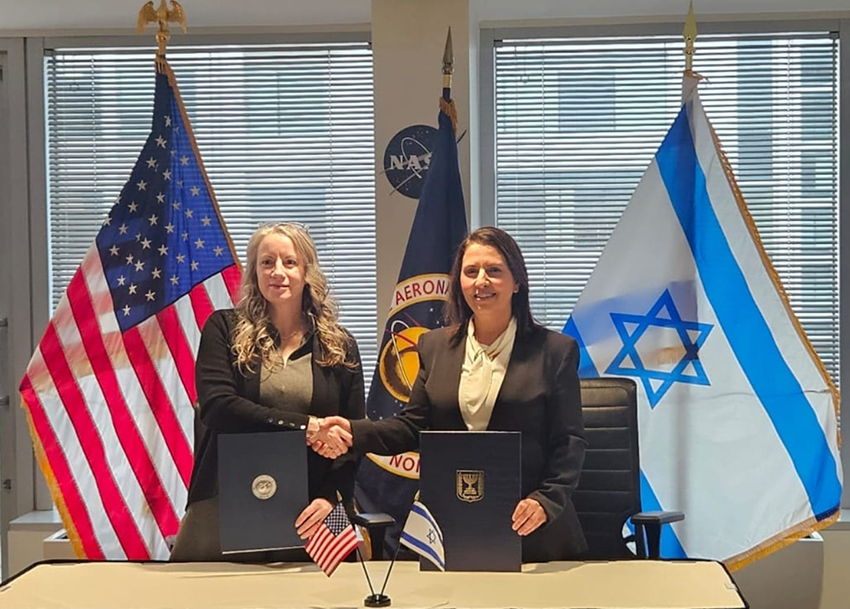
Exploring the possibility of involving the private sector in launching an Israeli woman astronaut into space. Minister Gamliel with NASA Deputy Associate Administrator Meredith McKay | Photo: Spokesperson, Ministry of Innovation and Science
A Soft Landing
Three crew members returned to Earth this week from the International Space Station after an eight-month mission. Russian cosmonauts Sergey Ryzhikov and Alexey Zubritsky, together with U.S. astronaut Jonny Kim, touched down on the Kazakh steppe early Tuesday morning—less than three and a half hours after the Soyuz MS-27 spacecraft undocked from the station. Following standard procedure, the crew underwent routine medical checks at the landing site and further examinations at a hospital in Kazakhstan before continuing on to Moscow and Houston.
Their return also marked the end of Expedition 73 aboard the International Space Station, which has been continuously crewed for more than 25 years. Seven astronauts now remain on board: three Americans, three Russians, and one Japanese crewmember.
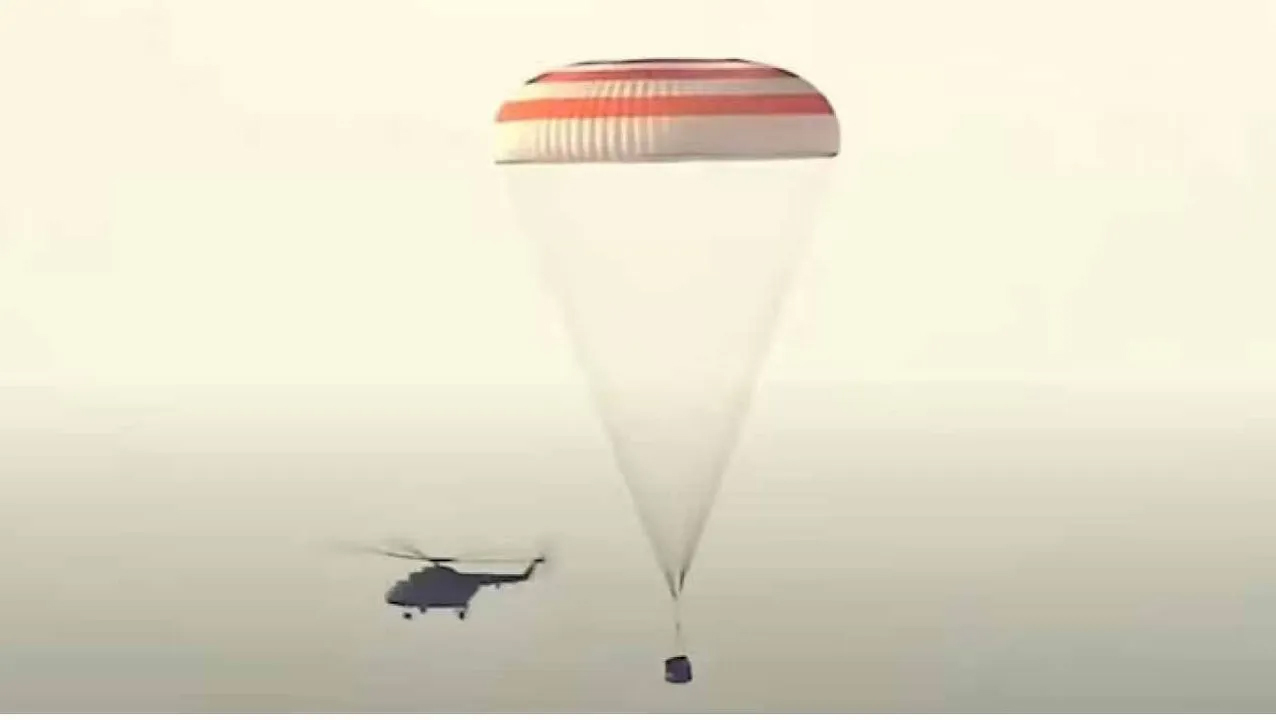
The Soyuz MS-27 capsule descends into Kazakhstan, with a rescue-team helicopter already en route to the landing site | Photo: Roscosmos
Window Update
Two of the three crew members aboard China’s Tiangong space station spent about eight hours outside the station this week, focusing on photographing and documenting damage to a window on the Shenzhou 20 spacecraft docked there. Shenzhou 20 was originally set to return its crew to Earth in early November, after a six-month mission, but a routine pre-departure inspection revealed a crack in its window, apparently caused by space debris—prompting China’s space agency to delay the return.
Ultimately, the crew returned to Earth aboard Shenzhou 21, the spacecraft that delivered their replacements. About two weeks later, China launched another spacecraft to Tiangong.Originally intended to carry the next crew, it was launched uncrewed to provide the station with an emergency return option.
In a statement, the agency said astronauts Wu Pei and Zhang Lu completed several maintenance tasks during the spacewalk and also conducted a close inspection—along with detailed photography—of Shenzhou 20’s damaged window. The agency plans to return the spacecraft to Earth on an uncrewed flight. The images and inspections are expected to support that effort, while also helping engineers determine the cause of the damage and consider design changes that could reduce the risk of similar incidents in future spacecraft.
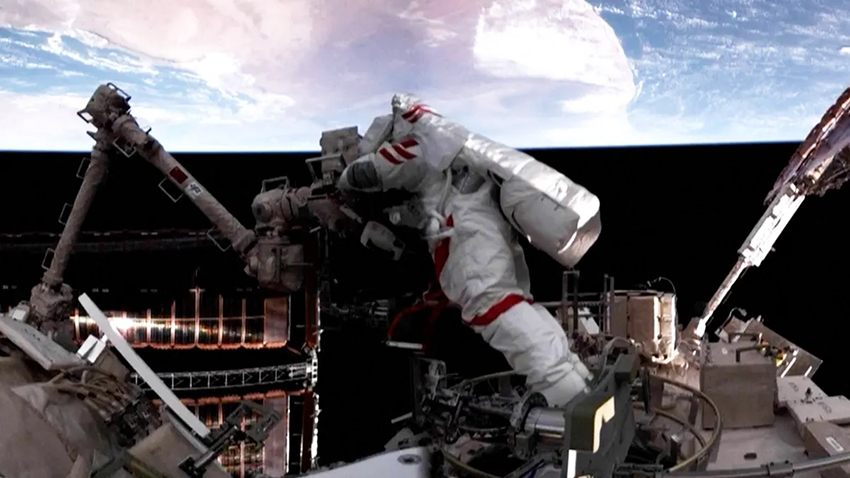
Information about the damage to the spacecraft docked to the station could help bring it back to Earth. One of the astronauts during this week’s spacewalk outside Tiangong | Photo: CCTV
In Search of an Atmosphere
In 2017, astronomers discovered the intriguing TRAPPIST-1 planetary system, which includes seven planets orbiting a red dwarf star just about 40 light-years away. The system drew particular attention not only because it is relatively close—in cosmic terms—but also because the planets are roughly Earth-sized. Three of them—TRAPPIST-1e, TRAPPIST-1d, and TRAPPIST-1f—lie within the star’s “habitable zone,” meaning their distance from the star could allow surface temperatures that support the presence of liquid water. Researchers often search for planets that might host watery environments, because in every place we have found life so far—namely, on Earth—it developed in such conditions.
However, temperature alone does not guarantee water on a planet’s surface. Water must be present to begin with, and just as importantly, the planet needs an atmosphere to keep it from escaping into space. In recent years, efforts have been made to determine whether these planets have stable atmospheres, mainly using observations and spectral measurements from the James Webb Space Telescope. Analysis of the most recent findings suggests that TRAPPIST-1d most likely has no atmosphere.
For its neighboring planet, TRAPPIST-1e, the picture is much less clear. A series of papers published in recent weeks, based on James Webb observations and measurements, raises the possibility of a methane-rich atmosphere (CH₄) on the planet. The key question is how much methane is actually there. Some studies caution that the amount is difficult to pin down and that the signal could be affected by material from the nearby star—in which case the findings would not necessarily point to an atmosphere at all. Other reports suggest the planet could have a dense atmosphere, potentially making it something like an analogue of Titan, Saturn’s large moon.
Clearer answers will likely come from future space missions, including NASA’s Habitable Worlds Observatory (HWO), intended to search for habitable worlds, and NASA’s Pandora mission, designed to study exoplanet atmospheres. Both are slated for launch in the coming years and could expand the search for life in the universe—at least as we understand it.
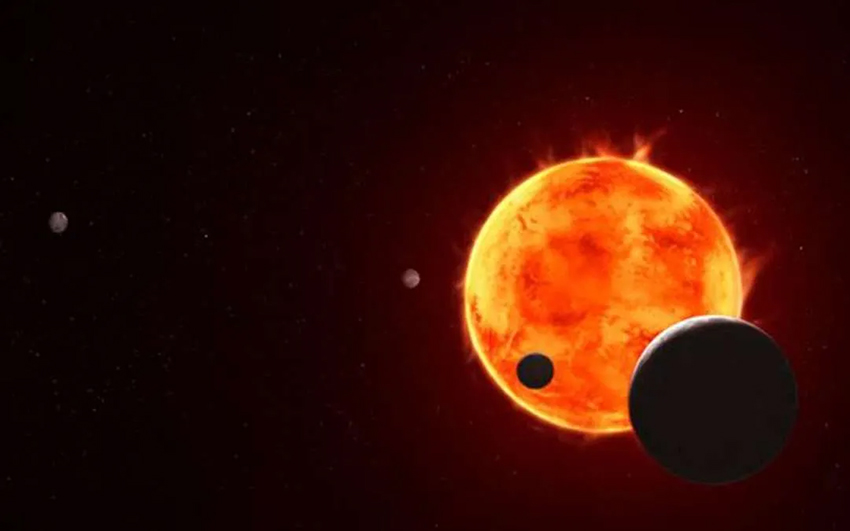
The first step toward searching for signs of life is identifying a planet with an atmosphere. An illustration of the TRAPPIST system, where seven Earth-like planets orbit a red dwarf star | Illustration: NASA/ESA/CSA/STScI/Joseph Olmsted (STScI)