A Launch Stand-Down and a Million-Satellite Plan: This Week in Space
Falcon 9 launches were suspended after a rare anomaly; SpaceX is merging and seeking approval to deploy one million satellites; an Israeli partnership with the International Space University, and a small victory for darkness. This Week in Space

8 February 2026
|

7 minutes
|
Falcon Grounded
SpaceX has suspended launches of its Falcon 9 rocket—its workhorse—after a rare second-stage malfunction during a routine mission. The rocket launched last Monday from Vandenberg Space Force Base in California, deploying 25 Starlink communications satellites. The first stage landed as planned on a drone ship at sea, but after satellite deployment the second stage failed to perform the maneuver that would have sent it to burn up in the atmosphere. As a result, the second stage did not burn up. Instead, it executed an emergency fuel-venting procedure designed for such scenarios, which brought it into a lower orbit, and is expected to reenter and burn up soon during atmospheric reentry.
The company has paused Falcon 9 flights while it investigates the anomaly in coordination with the U.S. Federal Aviation Administration (FAA). NASA is also taking part in the review, since SpaceX uses Falcon 9 to launch astronauts and cargo resupply missions for the agency. NASA’s immediate concern is whether the investigation could delay the next crewed launch to the International Space Station, currently targeted for the coming week. The station is presently being operated by just three crew members after a four-person crew returned earlier than planned last month due to a medical emergency. The next crew – Crew-12 – is currently scheduled to launch on Wednesday, February 11, aboard a SpaceX Dragon spacecraft. If the stand-down continues, that mission could also be delayed, potentially forcing delays or cancellations of experiments on the space station because of the reduced staffing.
Falcon 9 is not only SpaceX’s workhorse but also one of the most reliable rockets ever flown. In 2025, the company carried out 165 Falcon 9 launches—roughly comparable to the total number of launches worldwide by all other countries combined. The previous second-stage issue occurred about a year and a half ago, when an oxygen leak kept Starlink satellites from reaching their intended orbit. Flights were paused for two weeks while engineers worked to identify the source of the problem and fix it.
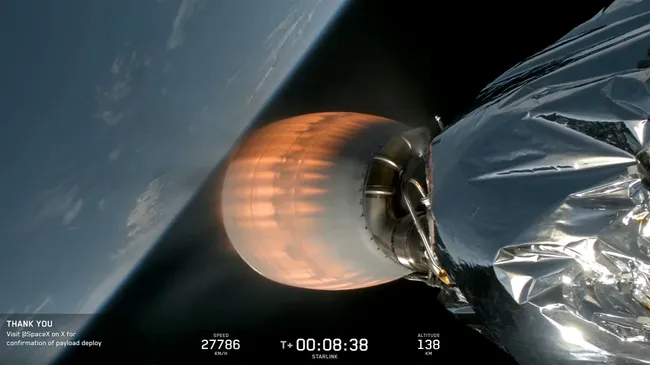
A rare anomaly. Footage from Falcon 9’s second stage after deploying Starlink satellites, before it failed to execute the maneuver intended to trigger a rapid burn-up in the atmosphere | Screenshot from SpaceX’s broadcast”
A Million Satellites in Orbit
On the business front, SpaceX announced this week that it is acquiring another Elon Musk company: the artificial intelligence firm xAI. According to the acquisition documents, SpaceX is valued at $1 trillion, and xAI is said to be worth $250 billion, though it is currently losing significant amounts of money. In the coming months, Musk plans to take SpaceX public to raise capital from the markets. The merger points to Musk’s next ambition: building data centers in space to expand the computing power needed for AI systems.
Satellite-based data centers could run on solar power in space and avoid much of the energy burden of cooling that earthbound facilities face. Ground-based data centers consume vast amounts of electricity for both operation and temperature control. Still, launching and operating a vast satellite constellation would come with enormous costs of its own. “My estimate is that within 2 to 3 years, the lowest cost way to generate AI compute will be in space,” Musk wrote in an email to SpaceX employees on February 2nd. He noted that, in his view, Starship spacecrafts will begin launching next-generation V3 Starlink satellites into orbit as early as this year, along with Starlink satellites capable of direct-to-mobile connectivity. He said that the need for large numbers of satellites—for both the communications network and space-based data centers—will be a “forcing function” in improving the performance of Starship, the massive spacecraft still in testing and development. “The sheer number of satellites that will be needed for space-based data centers will push Starship to even greater heights,” Musk wrote. “With launches every hour carrying 200 tons per flight, Starship will deliver millions of tons to orbit and beyond per year, enabling an exciting future where humanity is out exploring amongst the stars.”
Alongside Musk’s far-reaching vision, SpaceX has taken concrete steps. Last week, the company filed a request with the U.S. Federal Communications Commission (FCC) seeking approval to deploy one million satellites for a space-based data-center network. According to the filing, the satellites would operate at altitudes between 500 and 2,000 kilometers. SpaceX currently operates more than 9,000 active satellites in the Starlink network—far more than any other company or country—but scaling by several orders of magnitude to a million satellites would pose major challenges: unprecedented demands on engineering and day-to-day operations, potential impacts on astronomy and interference with telescopes, and the need to prevent collisions and curb the growth of space debris. The company has also recently announced development of a space situational awareness system intended to reduce the risk of satellite-to-satellite collisions.
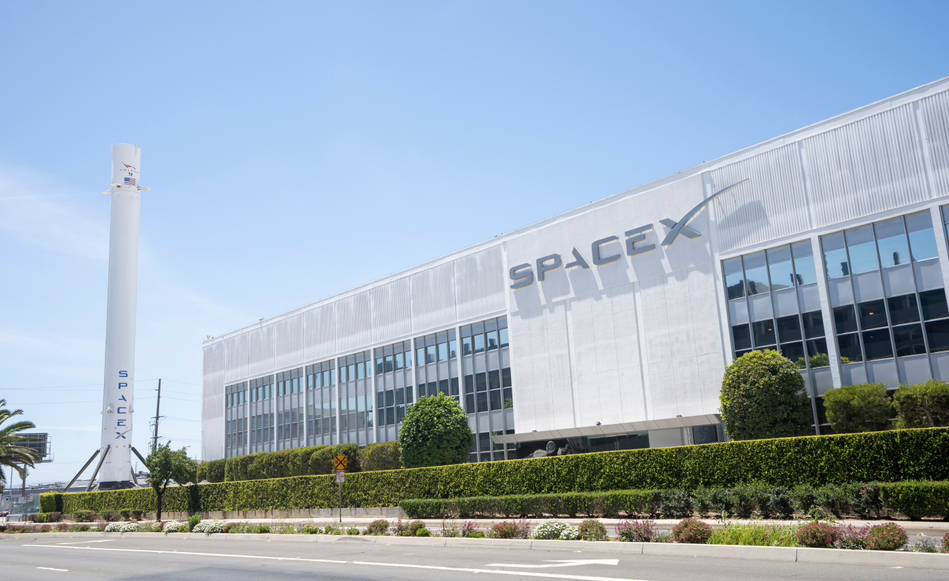
A merger on the way to an IPO, and plans to reach a million satellites in space. SpaceX headquarters in Hawthorne, California | Photo: Tada Images, Shutterstock
A Space University Partnership
The Rakia Mission and the International Space University (ISU) have signed a memorandum of understanding to expand cooperation, including bringing more Israelis into ISU programs, developing joint initiatives and applied projects, and advancing shared training programs. Rakia Mission says the agreement is intended to create a clearer pathway for Israeli students and entrepreneurs to enter the global space industry, while strengthening Israel’s presence in international decision-making and influence hubs in the sector. Last year, Eytan Stibbe—the Israeli private astronaut, Rakia Mission founder, and a member of its board—was appointed the ISU’s Chancellor (honorary president).
“This collaboration with ISU is designed to turn space into a tangible professional pathway for Israel,” said Rakia Mission CEO Hadar Vernik-Shilo. “The agreement defines concrete steps that connect academic knowledge, international experience, and real-world needs, as part of building the next generation of Israel’s space industry.”
“This partnership with Rakia Mission reflects International Space University’s commitment to building meaningful, regionally grounded collaborations that strengthen the global space ecosystem. Together, we are creating new pathways for education, workforce development, and alumni engagement—starting with Israel as a pilot model,” said ISU President Dr. John Wensveen. “Rakia’s leadership and convening power, combined with ISU’s global academic platform and alumni network, position this collaboration to deliver real, sustainable impact.”
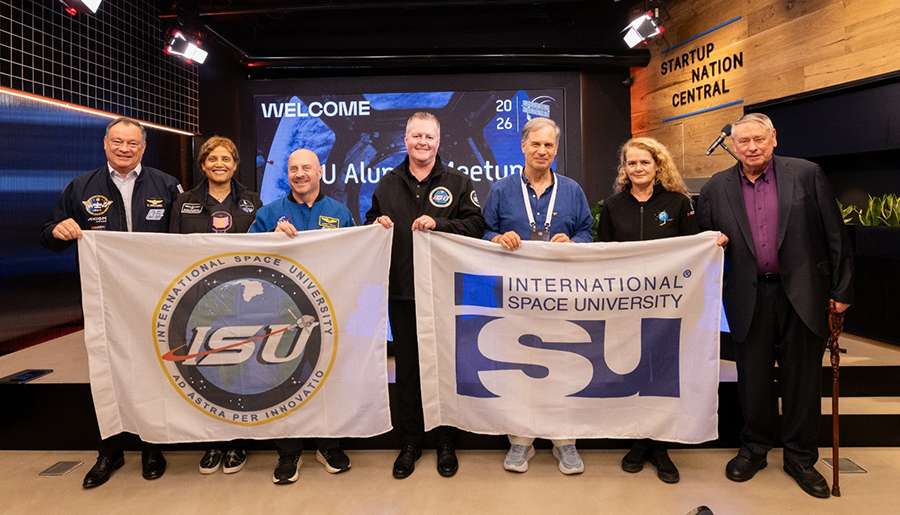
Steps toward building the next generation of Israel’s space industry. Eytan Stibbe (third from the right) and John Wensveen (fourth from the right) with ISU flags, alongside scientist Pete Worden (right), and astronauts (right to left) Julie Payette, Garrett Reisman, Sian Proctor, and Michael López-Alegría, who took part in Israeli Space Week events | Photo: Kfir Moalem, Rakia Mission
Let There Be… Less Light
AES Andes—a Chile-based power generator and a subsidiary of U.S.-based AES – has dropped plans for the INNA project – a plan to construct a large green hydrogen and green ammonia production facility in northern Chile near the Paranal Observatory, home to several of the European Southern Observatory’s (ESO) flagship telescopes. Northern Chile’s Atacama Desert is one of the world’s premier locations for astronomy, thanks to its remoteness from population centers and artificial light, its high elevation and thinner atmosphere, and its exceptionally dry, stable air with few clouds. Astronomers had warned that the proposed plant could degrade observing conditions through increased light pollution, minor ground vibrations, dust, and localized air turbulence.
Among the facilities at Paranal are the Very Large Telescope (VLT), one of the world’s premier optical observatories, and the VLT Interferometer, which combines four telescopes—each with an 8.2-meter primary mirror—into a single observing system. Nearby, construction continues on the Extremely Large Telescope (ELT), slated to begin operations in the coming years and become the world’s largest optical telescope.
AES previously submitted an environmental assessment arguing that the project’s impact on astronomy would be minimal. ESO countered with its own analysis, estimating that light pollution alone could rise by 35%. In announcing the reversal, AES did not give a specific reason for canceling the roughly $10 billion Andes project, saying only that it has chosen to focus its efforts on the development and construction of its renewable energy sources and energy storage portfolio.
“When the cancellation is confirmed, we’ll be relieved that the INNA industrial complex will not be built near Paranal. Due to its planned location, the project would pose a major threat to the darkest and clearest skies on Earth and to the performance of the most advanced astronomical facilities anywhere in the world,” said ESO Director General Xavier Barcons. “ESO and its Member States are fully supportive of energy decarbonisation and initiatives that ensure a more prosperous and sustainable future. Green-energy projects — and other industrial projects that drive national and regional development — are fully compatible with astronomical observatories, if the different facilities are located at sufficient distances from one another.”
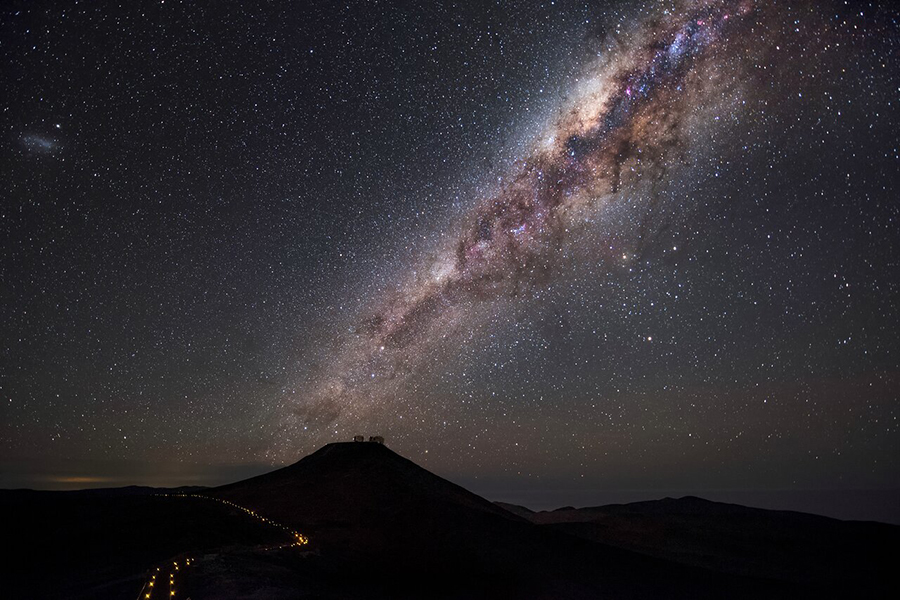
Preserving dark, clear skies. The Paranal Observatory, 2,600 meters above sea level, with the Milky Way in the background | Photo: A. Ghizzi Panizza/ESO