


According to the Standard Model of particle physics, every particle in the universe has a counterpart with the opposite electric charge, called an antiparticle—or, more generally, antimatter. Although we don’t encounter antimatter in everyday life, it plays a role in many physical phenomena, including radioactive decay and extremely high-energy processes. In a recent study at CERN’s Large Hadron Collider (LHC) near Geneva, researchers identified new features of antimatter’s behavior linked to a fundamental question: why is the universe made mostly of matter rather than antimatter? In their paper, they report evidence of symmetry breaking between matter and antimatter in particles more akin to the matter that surrounds us – suggesting the two are not perfect mirror images of one another. To understand what was measured at the accelerator and which symmetry was broken, it helps to return to the beginning of the story: what antimatter is, how it was discovered, and how the idea emerged that every particle has an opposite twin.
Why the Universe Prefers Matter: A Crack in the Matter – Antimatter Mirror
 22 February 2026
  6 minutes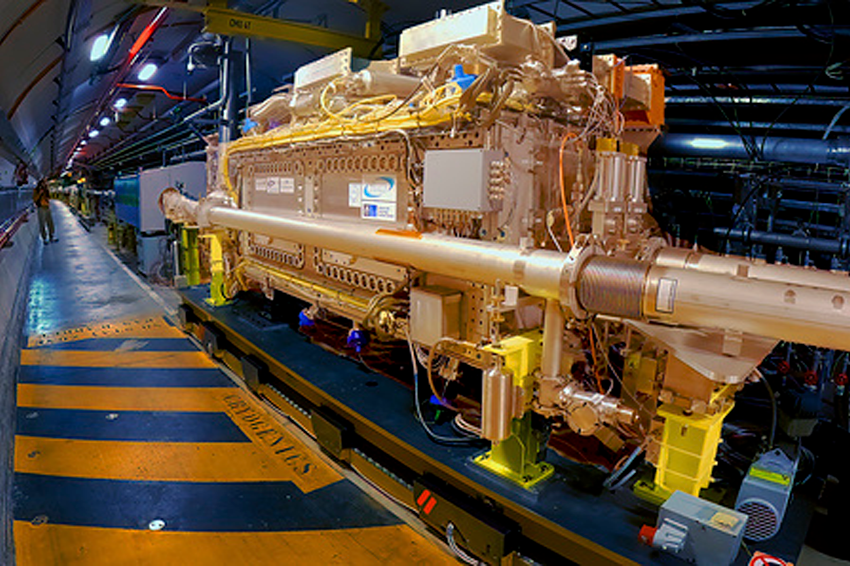
Same, but Opposite
The story of antimatter in science began in the late 1920s. The British physicist Paul Dirac sought a theory that would unite quantum mechanics with special relativity to explain experimental results from that period on atomic structure. He developed what became known as the theory of relativistic quantum mechanics (RQM), which matched the experimental data with striking accuracy. But the theory also produced an unexpected implication: every quantum particle should have a partner that is nearly identical in every respect—except that its electric charge is reversed. If a particle carries a positive charge, there must be an otherwise identical particle with a negative charge, and vice versa.
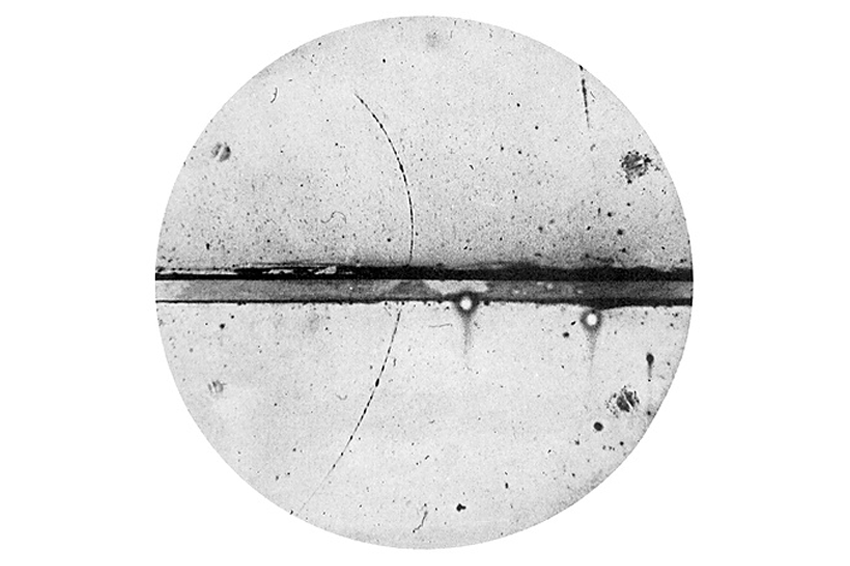
At first, the physics community – including Dirac himself – treated the idea as a theoretical curiosity. But just four years later, a surprising discovery changed the picture. The American physicist Carl Anderson studied cosmic rays—a flux of high-energy particles originating in space and reaching Earth.Because of their high energy, when these rays strike matter they can trigger interactions that break particles apart and produce showers of secondary particles, and Anderson investigated the products of those collisions. In the course of his work, he observed a particle that behaved exactly like an electron, except that it carried a positive charge rather than a negative one. In his paper, he named it the positron—short for “positive electron.” Four years later, he received the Nobel Prize in Physics for his discovery.
Where Did The Antimatter Go?
After we breathe a sigh of relief and accept that the matter around us is ordinary, a deeper question remains: why is that the case?
One possible explanation is that the universe does contain large amounts of antimatter – it’s simply far from us. If so, we would expect to detect high-energy radiation from matter-antimatter collisions in regions where dense concentrations of antimatter come into contact with ordinary matter. The problem is that we do not observe such radiation anywhere. Even with today’s most advanced space telescopes, we have not found regions of the universe that show this kind of signature, which makes this scenario unlikely.
A second possibility is that the universe once contained equal amounts of matter and antimatter, but the antimatter was destroyed while the matter remained. This, too, is hard to reconcile with what we know, because during annihilation matter and antimatter should be consumed in equal measure. If the universe began with equal quantities of each, simple annihilation alone would leave equal amounts behind.
The remaining possibility is that matter and antimatter differ in some additional way, so that certain physical processes tip the balance , giving matter an advantage over antimatter.
A Distorted Mirror
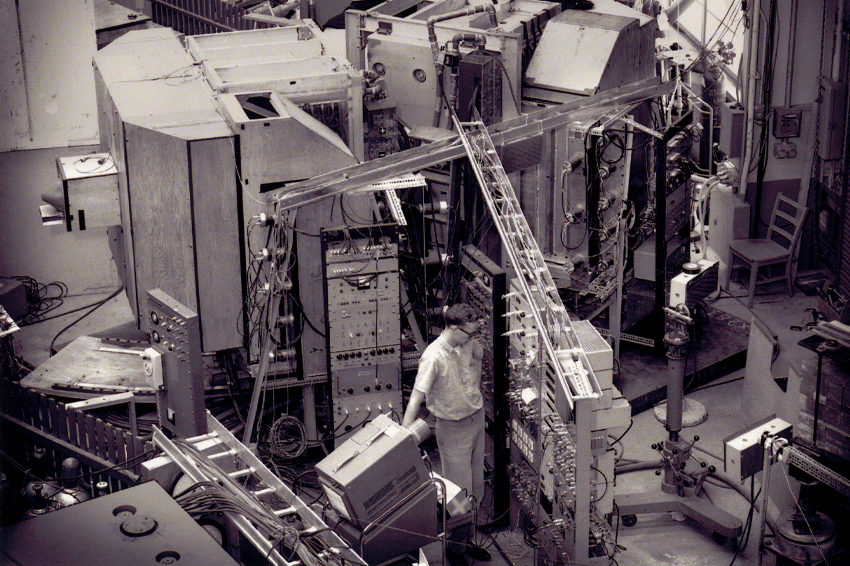
A little more than thirty years after the discovery of antimatter, evidence began to emerge for processes that could favor matter over antimatter. In 1964, an experiment at Brookhaven National Laboratory, led by James Cronin and Val Fitch of Princeton University, examined the behavior of unstable particles called kaons, which are composed of fundamental constituents known as quarks. More specifically, a kaon consists of a heavy quark—one with relatively large mass—paired with a light antiquark, or vice versa.
The experiment showed that one type of kaon can transform into another in a way that does not preserve the symmetry between matter and antimatter. This was the first evidence that, under certain conditions, matter and antimatter do not behave as perfect mirror images. This discovery – known as charge-parity (CP) violation, earned Cronin and Fitch the Nobel Prize in Physics in 1980.
What makes a broken symmetry important enough to earn a Nobel Prize—and what does ‘symmetry’ mean in physics? In everyday life, we encounter symmetries all the time. Take a snowflake: rotate it by 60 degrees and it still looks exactly the same. In modern physics, a symmetry is a transformation you can apply to a system without changing the way it behaves.
Symmetries play a central role in physics: once we know which symmetries a system obeys, we can learn a great deal about it—and even rule out certain processes entirely.
For many years, physicists assumed that nature preserves mirror symmetry—that a mirror-image universe would behave exactly like our own. But in 1957, an experiment led by Chien-Shiung Wu overturned that assumption. Afterward, many believed that a mirror universe would behave the same way if we also swapped all matter for antimatter. That, however, is precisely the symmetry Cronin and Fitch showed can be broken. Today, physicists think the symmetry is restored only if we reverse the time dimension as well. In other words, only a mirror universe in which matter is replaced by antimatter and time runs backward would behave exactly like ours.
For decades, scientists tried to observe this kind of symmetry breaking in particles closer to the matter that surrounds us in everyday life, but without success. Kaons are composed of two quarks, whereas most of the familiar particles in the universe—including protons and neutrons—consist of combinations of three quarks.
Until recently, charge–parity (CP) violation had not been observed in such three-quark particles. In a recent paper in Nature, researchers reported that, at CERN’s Large Hadron Collider (LHC), they observed CP violation with high confidence in particles composed of three quarks. Moreover, the measurements suggest that CP violation in these particles has features that differ from what was previously seen in two-quark particles. That difference is especially intriguing because the Standard Model of particle physics cannot fully account for it – raising the possibility of new, as-yet-unknown physics.
This observation is remarkable for two reasons. First, it provides strong evidence for a fundamental process that scientists have sought to observe for decades. Second, charge–parity (CP) violation is one of the key conditions required for antimatter to be destroyed at a higher rate than matter. More precisely, it points to a mechanism by which matter and antimatter can behave differently. Researchers hope that observations like these will help clarify those differences – and perhaps bring us closer to understanding why our universe is made almost entirely of matter.
Translated with the assistance of ChatGPT. Edited, revised, and reviewed by the editorial staff of the Davidson Institute of Science Education.