Astronomical Alerts and a Launch Delay: This Week in Space
The crewed lunar mission slips to at least April, NASA names the astronaut behind an early ISS return, SpaceX sets more records, Rubin’s new alerts are poised to transform astronomy, and a lunar eclipse. This Week in Space

1 March 2026
|

7 minutes
|
NASA has rolled the Artemis 2 rocket off the launch pad for repairs, and the first crewed flight around the Moon is now expected no earlier than April.
In early February, NASA conducted a fueling test of the launch vehicle and detected a hydrogen leak, forcing the agency to push the planned launch to March 6. A repeat test roughly a week ago was successful, but during subsequent launch preparations engineers found a problem with helium flow into the rocket’s fuel system. The team concluded the best solution was to return the vehicle to the Vehicle Assembly Building, where the necessary repairs can be carried out.
SLS is slated to launch the Orion spacecraft on its first crewed mission. This will be only the rocket’s second flight, after its successful debut on the uncrewed Orion 1 mission in late 2022 – also delayed repeatedly by leaks and other malfunctions. The rocket runs on liquid hydrogen and liquid oxygen, but because its second stage is designed to operate in space, it also carries helium. In microgravity, propellant can spread inside the tank, so helium is used to pressurize the system and ensure a steady flow of hydrogen and oxygen to the engine.
NASA will now await the next launch window, which opens April 1. The long gaps between windows reflect the Moon’s roughly month-long orbit around Earth and the need for the proper geometry for the mission trajectory. The astronauts, who had entered pre-launch quarantine to reduce the risk of illness during the flight, have been released and have returned to normal training and mission preparations.
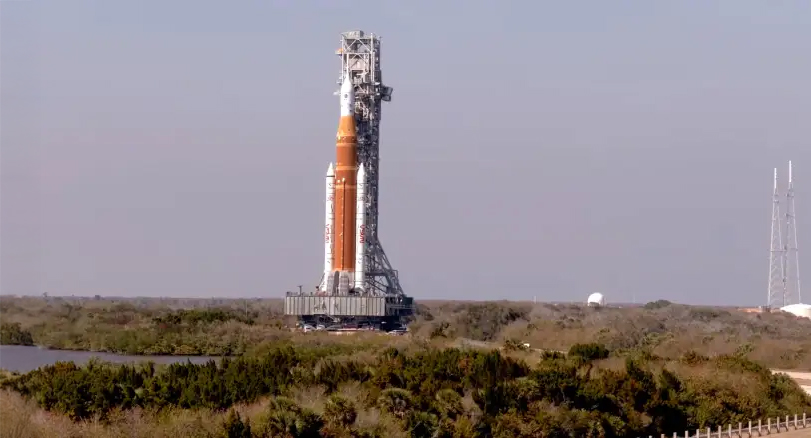
More than three years after the first launch, some of the same issues are resurfacing. The SLS rocket is transported back to the maintenance facility this week | Photo: NASA TV
Medical Confidentiality
More than a month after a crew of four astronauts was returned from space due to a medical issue affecting one of them, NASA revealed that the astronaut who required an early return was 58-year-old Mike Fincke. The agency, however, did not disclose details about the condition that led to the mission being cut short.
“On Jan. 7, while aboard the International Space Station, I experienced a medical event that required immediate attention from my incredible crewmate,” Fincke wrote in a statement distributed by NASA. “Thanks to their quick response and the guidance of our NASA flight surgeons, my status quickly stabilized. After further evaluation, NASA determined the safest course was an early return for Crew-11 — not an emergency, but a carefully coordinated plan to be able to take advantage of advanced medical imaging not available on the space station.” Fincke added that he is now doing very well and is continuing the standard post-flight reconditioning that follows a long-duration space mission.
At a press conference a few days after the landing, Fincke hinted at the nature of the medical issue, noting how important it is to have an ultrasound device on the station. His latest statement adds another clue by referencing the need for imaging equipment not available aboard the ISS, and it is possible that the medical reason for the early return will be disclosed later.

The identity of the patient has been revealed. Fincke (left) and his crewmates on the mission at the space station (right): Oleg Platonov, Kimiya Yui, and Zena Cardman | Photo: NASA/Robert Markowitz
Falcon Breaks Records
SpaceX’s Falcon 9 has steadily taken over much of the global launch market in recent years, helped by the company’s ability to reuse the rocket’s first stage again and again. The past week brought another milestone: the record-holding booster for most flights, B1067, launched once more, completing its 33rd trip to space. The mission lifted off Saturday from Cape Canaveral, Florida, to deploy Starlink satellites into orbit, and the booster returned to land successfully on a droneship in the Atlantic Ocean. The achievement moves SpaceX another step closer to its goal of flying each Falcon 9 first stage up to 40 times.
A separate launch on Wednesday marked another benchmark, pushing SpaceX past 500 Starlink satellites launched since the start of the year. The company’s satellite-internet constellation is also nearing 10,000 active satellites, toward a first-phase goal of 12,000. SpaceX says it plans to seek approval to expand the network to as many as 30,000 satellites.
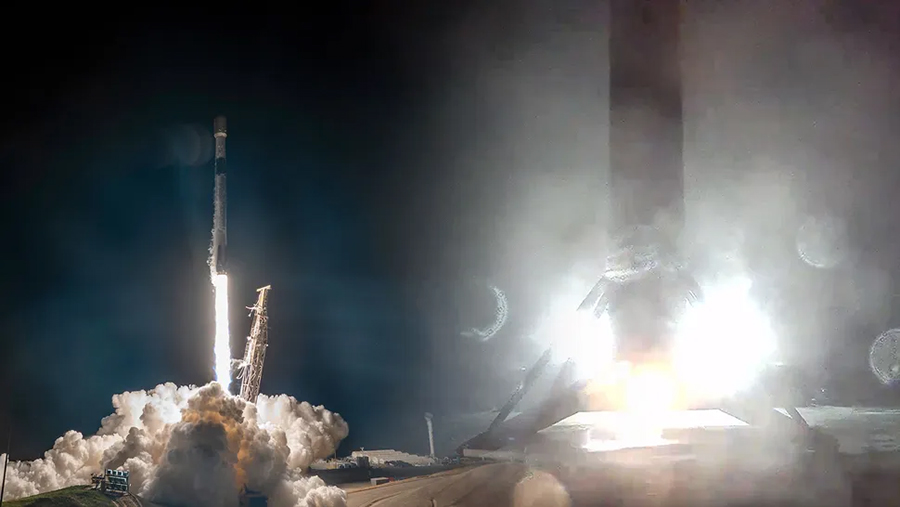
Another milestone in a long list of records. The launch and droneship landing (right) of the record-setting first stage for repeat trips to space | Photos: SpaceX
Incoming: A New Alert From Space
The Vera C. Rubin Observatory in Chile has begun sending automated alerts to scientists about new space observations, to draw astronomers’ attention to potentially significant events and enable rapid follow-up with additional telescopes. On its first night of operation this week, the alert system issued about 800,000 messages, and operators estimate the total could grow to seven million alerts per night over time.
Built in Chile with funding from the U.S. National Science Foundation (NSF) and the U.S. Department of Energy, the telescope scans the Southern Hemisphere sky and captures an image roughly every 40 seconds. The images are transmitted to the observatory’s data-processing center in California, where advanced software – assisted by machine learning – compares each exposure with earlier images of the same region and searches for changes: objects that appear or disappear, shift position, or change in shape or brightness. A verification step—known as the Verification and Validation architecture—reviews the detections and distributes alerts to the scientific community within minutes. Researchers—and the public—can access the data directly or through distribution programs that focus on specific kinds of cosmic events, so each scientist receives the alerts most relevant to their work.
The alert system is expected to help researchers worldwide spot phenomena such as supernovae and other stellar explosions, star formation, changes in galaxies, radiation outbursts, stars being swallowed by black holes, stellar mergers, and nearer-to-home events such as asteroids moving through the solar system.
The Vera Rubin Observatory began operating last year, and the completion of the alert system is the final major step before it launches the massive LSST sky survey. Over the course of ten years, the telescope will repeatedly map the southern sky and collect more astronomical data than all previous observations combined.
“Rubin’s alert system was designed to allow anyone to identify interesting astronomical events with enough notice to rapidly obtain time-critical follow-up observations,” said Eric Bellm of the NSF NOIRLab and the University of Washington, who leads one of the telescope’s alert distribution groups. “Enabling real-time discovery on 10 terabytes of images nightly has required years of technical innovation in image processing algorithms, databases, and data orchestration. We can’t wait to see the exciting science that comes from these data”
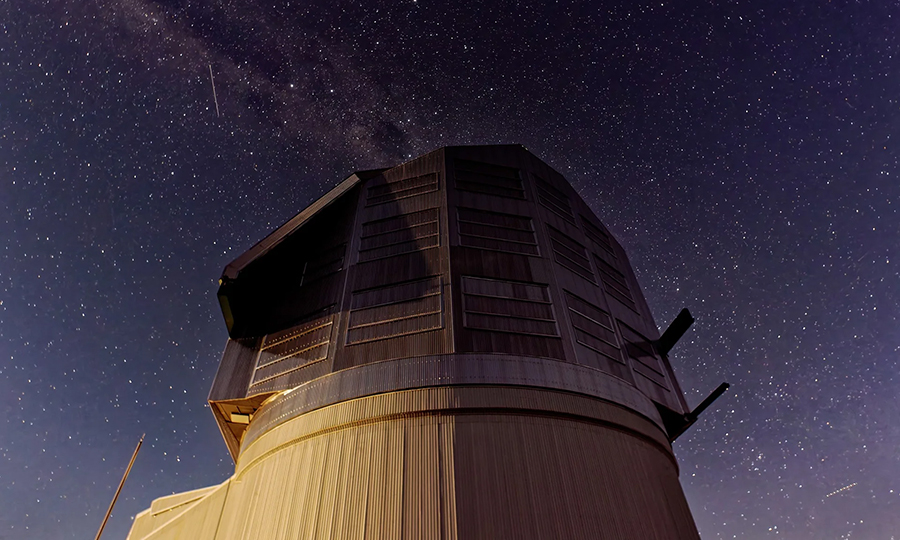
A system set to unlock a wealth of new astronomical discoveries. The Vera C. Rubin Observatory telescope under the night sky at Cerro Pachón, Chile | Photo: NSF–DOE Rubin Observatory/NOIRLab/SLAC/AURA/W. O’Mullane
Celestial Eclipse
A total lunar eclipse will occur this week, but it won’t be visible everywhere. A lunar eclipse happens when Earth passes between the Sun and the Moon, and its shadow falls across the full Moon, often turning it a deep red. Because the Moon’s orbit is tilted by about five degrees relative to the ecliptic plane—the plane in which Earth and most planets orbit the Sun—lunar eclipses don’t happen every month. Instead, they occur on average about twice a year, typically about two weeks apart from a solar eclipse. Indeed, two weeks ago a solar eclipse was visible mainly from Antarctica.
This eclipse will take place on the night between Monday and Tuesday and will be seen mainly over the Pacific Ocean. Totality will be visible in eastern Russia, eastern Australia, New Zealand, the Pacific islands, the western United States (especially Alaska), and western Canada.
It will be the last total lunar eclipse until Dec. 31, 2028. Viewers outside the totality zone may still catch a partial eclipse around moonrise or moonset—weather permitting.
Until the end of 2028, most upcoming eclipse events will be partial. On Aug. 28 2026, a partial lunar eclipse will be visible across parts of the world, with Earth’s shadow covering about 10–15% of the Moon’s disk in some regions. In February 2027, a penumbral lunar eclipse will occur, in which Earth’s shadow does not fall directly on the Moon but can subtly darken it and sometimes give it a faint reddish tint. By contrast, Aug. 2, 2027 will bring a partial but dramatic solar eclipse with the Moon covering more than 80% of the Sun in some locations.
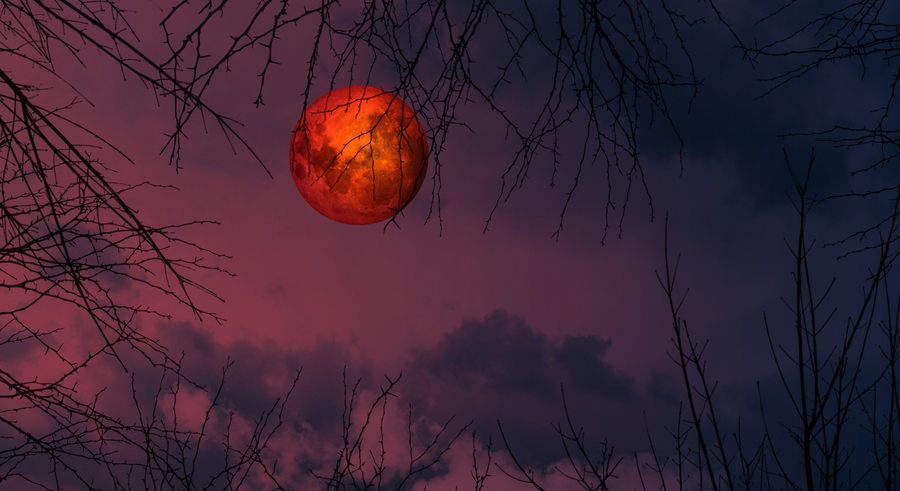
The Moon turns red as it passes through Earth’s shadow. A total lunar eclipse | Photo: Gergitek, Shutterstock