The Israeli Who Wants to Build a Home on the Moon Together With Space X
A project led by Dr. Shay Monat at the International Space University has caught the attention of SpaceX CEO Elon Musk - and could mark an important step toward establishing a crewed base on the Moon.

18 February 2026
|

6 minutes
|
“The International Space Station was constructed over years, from parts that were shipped on a large number of flights. Our solution will allow the creation of 2,500 cubic meters of living space on the Moon – twice the size of the entire station – in a single flight”, Dr. Shay Monat told the Davidson Institute’s website. “I have been advancing this project for several years already, but since Musk’s tweet I have received a lot of inquiries, and I hope to turn it into reality”.
Monat, who recently completed a PhD in mechanical engineering at Tel Aviv University and now works at the Technion, is a space enthusiast. In the summer of 2021, he took part in the International Space University’s summer program in France. A few months earlier, NASA announced that it had selected SpaceX’s Starship – then yet to fly in space – to serve as the lunar lander for the first crewed Artemis missions. In response, Monat chose for his ISU project a central question: whether, and how, Starship could be converted into a permanent habitat on the Moon.
The biggest challenge is that Starship is designed to land vertically, but converting it into a habitat requires laying it on its side. How do you lower a 50-meter-long, nine-meter-diameter metal cylinder onto the Moon—without cranes and without causing structural damage? “We solved the problem by using cables anchored to the ground at several points,” Monat explained. “Once it’s down, we cover it with regolith – lunar dust. While the covering is underway, astronauts can go inside, into the fuel tanks that make up most of the spacecraft’s volume, open them, remove the remaining fuel, install floors and equipment, and convert them into living and working spaces.”
The concept echoes early plans for the U.S space station Skylab, launched in 1973. NASA planned to build the station inside the Saturn V rocket’s fuel tank, and, after venting the remaining propellant into space, use the remaining internal volume as a living-and-working complex. Ultimately, the idea was not implemented for technical reasons.

Monat and his colleagues' original plan to lay down Starship on the moon, cover it in regolith, and redesign the interiors. Illustration from Monat and his colleagues’ original project.
Greenhouse and Gym
Conditions on the Moon are extremely harsh: temperatures swing from about 120°C during the lunar day to around minus 130°C at night, and the extremes are even greater at the poles. With no atmosphere, the lunar surface is exposed to dangerous radiation from space and to impacts from micrometeoroids – tiny particles that can travel at tens of thousands of kilometers per hour and cause serious damage upon impact. Covering Starship with an insulating layer of regolith could help shield it from temperature changes, micrometeoroids, and most radiation.
Monat and his colleagues’ plan divides the spacecraft – lying horizontally and, as noted, up to nine meters high – into three levels for habitation and work. “The top level will be a greenhouse for growing plants under artificial light,” Monat said. “They will help remove carbon dioxide from the air, produce oxygen and of course food, and also provide an additional layer of radiation shielding for the levels below. The crew’s living quarters will be on the lowest level, and therefore the best protected from radiation.”
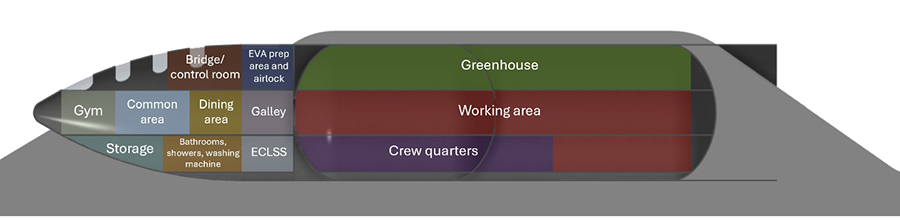
The fuel-tank section will be converted into a greenhouse for growing plants, a work area, and crew quarters in the lower level - the best protected from radiation. Diagram of the Starship lunar base’s internal layout | Illustration: Shay Monat.
The middle level, between the lab and the living quarters, will serve as a work area, where astronauts will be relatively well shielded from radiation thanks to the greenhouse above. The upper section of the spacecraft, near the rocket’s nose, will function as a logistics area, and its three decks will include, among other things, a kitchen and dining area, toilets and showers, storage, a gym, life-support systems, and an airlock through which crew members will enter and exit the habitat. The pit from which soil will be excavated to cover Starship will be dug so that its bottom remains in permanent shade, allowing radiators to be placed there to reject heat. With no atmosphere to carry heat away, keeping a lunar habitat cool is one of the key engineering challenges for any Moon base.
After completing the program at the International Space University, Monat and his colleagues presented the idea at the International Astronautical Congress in Dubai and, in 2023, published a paper summarizing the concept—but it did not receive the attention they felt it deserved. Monat continued to refine the idea alongside his doctoral studies, adapting it, among other things, to changes in Starship’s design. Since then, Starship vehicles have flown 11 test missions, and SpaceX now plans to test a third-generation version.
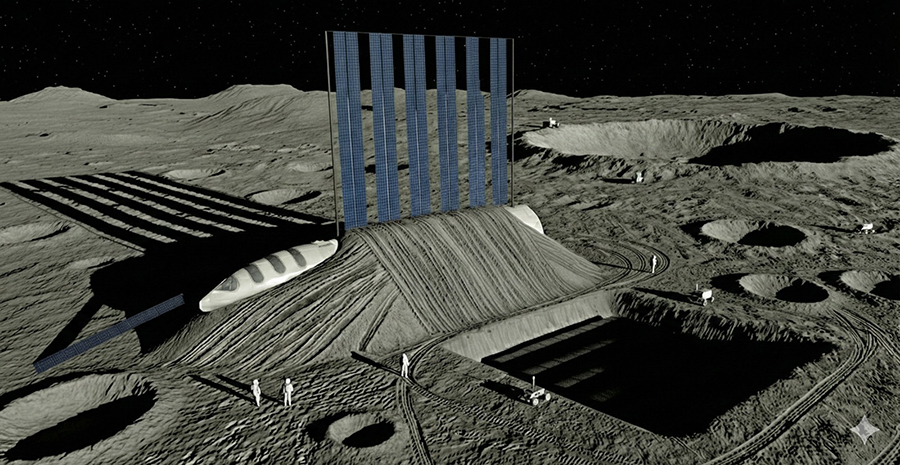
The regolith cover will provide insulation and protection. Rendering of a habitat based on a Starship lying on its side and covered with lunar dust. Illustration: Shay Monat, via Google Gemini.
“This will be so awesome 🤩”
Since founding SpaceX, Musk’s overarching goal – and the driving force behind Starship’s development – has been to establish a crewed colony on Mars. He has repeatedly said it is his top priority, but last week he unexpectedly announced that he is now prioritizing building a city on the Moon over establishing a settlement on Mars, and said it could happen within ten years.
Space engineer Toby Li responded on X by posting Monat and his colleagues’ plan from the Space University, along with a diagram outlining the sequence of steps for converting Starship into a habitat and a link to their paper. Musk shared Li’s post, adding: “This will be so awesome 🤩”.
Monat reposted Musk’s tweet, replying “It IS!” and suggesting they discuss it.
Since Musk’s tweet, Monat has been inundated with inquiries, and he is trying to reach Musk directly, hoping he will adopt the plan and perhaps help fund it. “I heard years ago that he was aware of the idea, and I’m putting all my energy into it,” he said. “The intention is to establish a company, but it’s still unclear where its revenue will come from. In principle, there is commercial potential in building a lunar base: mining and processing rare metals, an activity that on Earth is becoming ever more expensive and polluting, extraction of helium-3 for hydrogen fusion, and scientific projects. But it will take a decade before ventures like these generate revenue.”
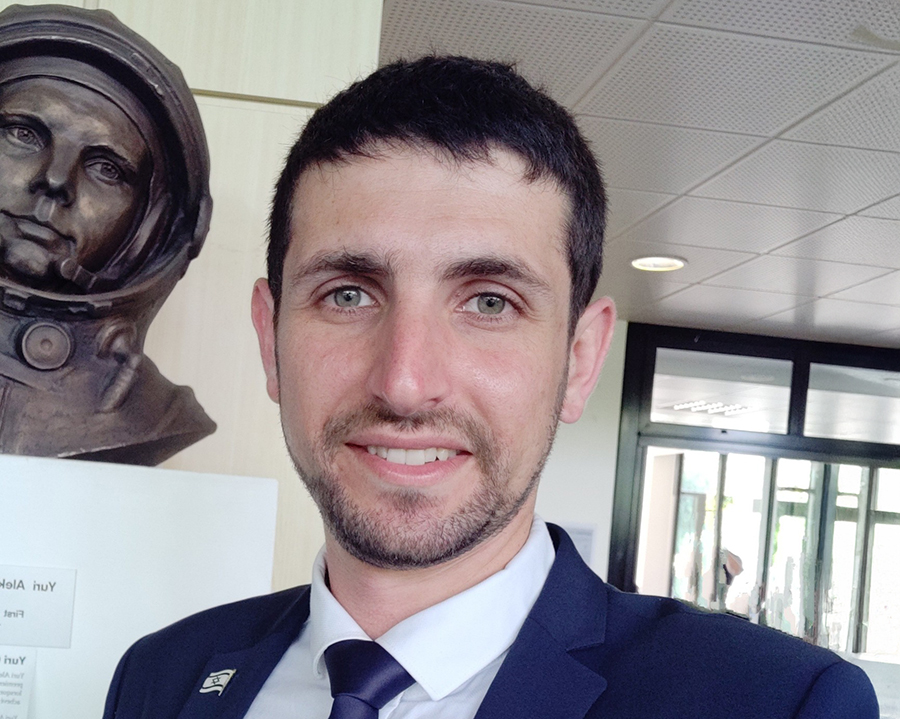
Wants to establish this base and be one of those who will live in it. Shay Monat | Photo courtesy of Monat
According to NASA’s plans, the Artemis program’s crewed missions will focus on the Moon’s South Pole, where frozen water likely lies at the bottoms of craters that sunlight never reaches. Another advantage of the region is that parts of the rim of Shackleton Crater are exposed to near-constant sunlight, enabling continuous solar power generation. According to Monat’s plan, solar collectors would be installed on the roof of the horizontal Starship to power the base—though NASA is also advancing plans for producing nuclear power on the Moon, which would reduce dependence on solar energy.
“Such a base could serve as the first seed of a crewed colony. It could enable teams to map ice resources near the South Pole, mine the ice, transport it and extract water from it, filter it, and – if necessary – split it into oxygen and hydrogen, while developing storage solutions for ice, water, or gases. I know NASA is also familiar with our idea, and during the last Space Week I presented it to Amit Kshatriya, NASA’s associate administrator, who visited here.”
Asked whether he would rather sell the idea to an agency like NASA or to a major company such as SpaceX instead of starting his own venture, Monat replied: “No! I want to build this base and settle in it myself!”