The Shifting Seasons of Carbon Dioxide
To truly understand the processes behind climate change, it isn’t enough to monitor atmospheric carbon dioxide levels—we must also recognize that these levels fluctuate seasonally and vary across different locations.
In every discussion about addressing the climate crisis, the continuous rise in carbon dioxide concentrations in the atmosphere is a key focus. Since the beginning of the industrial revolution, the concentration of this greenhouse gas has increased from 280 parts per million (ppm) to 420 ppm today. While these figures represent the global annual average, carbon dioxide concentrations actually vary by location and season throughout the year.
For example, during the peak growing season for various plants, certain areas experience a decrease in atmospheric carbon dioxide levels due to its sequestration by vegetation. This sequestration occurs through the process of photosynthesis, where plants convert carbon dioxide, sunlight, and water into sugars. Conversely, as plant growth slows, carbon dioxide is released back into the atmosphere through cellular respiration and the decomposition of organic matter. The difference between the highest and lowest carbon dioxide levels at a specific site throughout the year is known as the “seasonal carbon dioxide range.” Scientists closely monitor this range to gain a better understanding of how climate change is impacting the Earth.
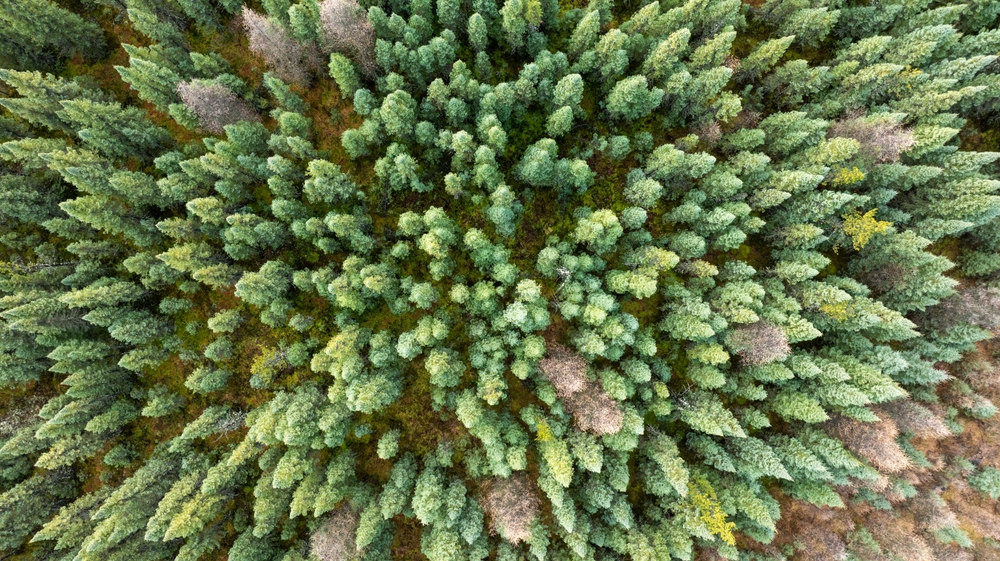
During the peak of the growing season, certain areas experience a decrease in atmospheric carbon dioxide levels due to its sequestration by vegetation. Forest in northern Canada | Vit Onoprienko, Shutterstock.
Changing Levels
In a recent review published in Nature journal, researchers analyzed findings from numerous studies to understand the factors and processes driving the seasonal variability of carbon dioxide. The review aimed not only to deepen our scientific understanding but also to highlight regions and processes where we need to improve our current monitoring and observation capabilities.
The seasonal range of atmospheric carbon dioxide levels varies by location, depending on the amount of vegetation and its seasonal cycles. On average, in the Northern Hemisphere, the range increases as one moves closer to the poles. In the far north, it can reach up to ten parts per million (ppm), while in the equatorial region, it ranges from 5 to 7.5 ppm. In contrast, the Southern Hemisphere experiences a much smaller range, typically not exceeding 2.5 ppm, due to the lower amounts of land and vegetation, resulting in smaller seasonal fluctuations.
With climate change, the seasonal range of carbon dioxide has increased in most parts of the Earth. However, scientists have observed that in northern regions above latitude 45, this change is happening particularly rapidly. With climate change, the seasonal range of carbon dioxide has increased in most parts of the Earth. However, scientists have observed that in northern regions above latitude 45, this change is happening particularly rapidly.
At northern latitudes, the minimum carbon dioxide concentration levels rise faster than the maximum levels. This gap results from the extended growing season due to rising temperatures, which allows for increased photosynthesis over more months of the year. While the increase in carbon sequestration from tree growth contributes to a cooling effect on Earth, the ongoing rise in temperatures reduces the extent of snow and ice-covered areas in these northern regions during the winter months. As a result, it increases the flow of radiation reaching Earth’s surface, further warming it.
Maximum carbon dioxide concentrations also rise at northern latitudes, particularly in the fall and early winter. During this period, higher-than-usual temperatures cause the permafrost to thaw, leading to the decomposition of organic matter and the release of carbon dioxide into the atmosphere.
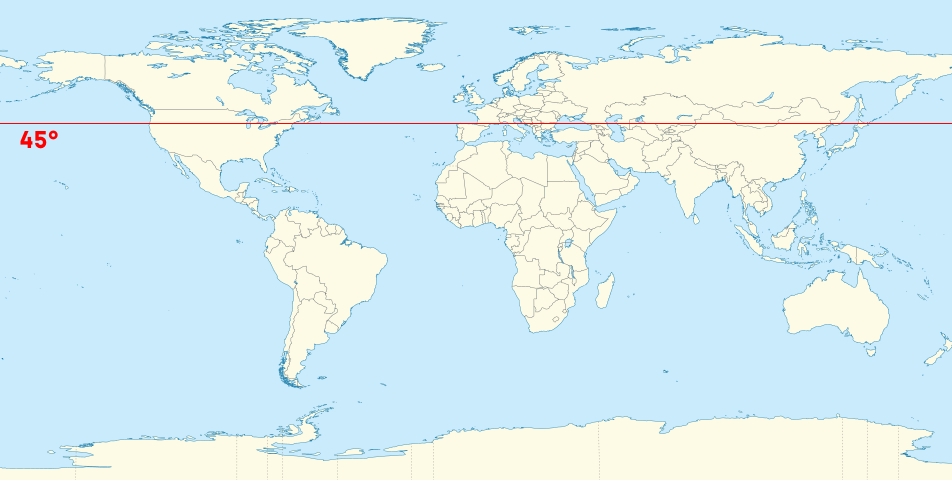
In northern regions above latitude 45, the seasonal range of carbon dioxide changes rapidly. 45th parallel north of the equator | Source: TUBS, Wikimedia.
התארכות עונת הפוטוסינתזה מסבירה לבדה 90 אחוז מהשינוי בטווח הפחמן הדו-חמצני בכל רחבי כדור הארץ. עם זאת, כשמסתכלים עליו באופן מרחבי, ניכר לעין שקצב השינוי אינו זהה בכל מקום, והסיבות לכך מגוונות. ליערות המחטניים בצפון יש תרומה גדולה במיוחד לשינויים בטווח הפחמן הדו-חמצני, שכן הם מקבעים הרבה ממנו בקיץ ופולטים מחדש יותר פחמן דו-חמצני בסתיו. הפער הזה אכן קשור קשר הדוק להתארכות עונת הפוטוסינתזה. לעומת זאת, ביערות הממוזגים ובאזורים קפואים ההשפעה ניכרת הרבה פחות והטווח לא צפוי לגדול במידה רבה.
קיימים גם הבדלים בין מזרח למערב באותם קווי רוחב. לדוגמה, אף על פי שבחלקים הצפוניים של אירופה ואסיה
The elongation of the photosynthesis season alone accounts for 90% of the change in the carbon dioxide range across the Earth. However, when examined spatially, it becomes clear that the rate of change is not uniform, and the reasons for this variability are diverse. Coniferous forests in the northern regions play a particularly significant role in altering the carbon dioxide range, as they sequester substantial amounts of carbon during the summer and release more carbon dioxide in the fall. This fluctuation is closely tied to the extension of the photosynthesis season. In contrast, temperate forests and frozen regions exhibit much less pronounced effects, and their carbon dioxide range is not expected to increase significantly.
Additionally, there are regional differences between the eastern and western hemisphere at the same latitudes. For instance, although the seasonal range in the northern parts of Europe and Asia is expected to increase significantly, the change in North America is anticipated to be much smaller. This discrepancy is largely due to the fact that North American forests are highly sensitive to droughts, which diminishes the additional carbon sequestration benefits from the extended photosynthesis season.
Based on models predicting the continued progression of global warming and the associated climate changes, researchers estimate that the seasonal range of carbon dioxide could increase substantially in the coming years. When comparing the observed increase between 1980 and 2020 to the projected rise in the seasonal range by the end of this century, some future warming scenarios suggest that the gap could expand by nearly 75%. The expected changes in the seasonal carbon dioxide range are primarily attributed to the elongation of the growing season in northern latitudes.
As global warming continues, researchers estimate that additional factors, such as changes in snow cover during the winter, glacier melt, and the thawing of previously frozen areas, will play an increasingly crucial role in shaping the Earth’s climate, including seasonal carbon dioxide levels in the atmosphere. To better understand the growing variability in seasonal carbon dioxide, scientists recommend significantly improving carbon dioxide monitoring systems, particularly in sensitive and remote regions like glaciers or northern forests in Siberia.




 12 January 2026
  5 minutes


