באתר זה נעשה שימוש בקבצי עוגיות בין היתר של צדדים שלישיים. חלקן חיוניות לחוויית גלישה תקינה וחלק משמשות לסטטיסטיקה ושיווק. המשך גלישה באתר מהווה הסכמה לשימוש זה. המידע נשמר בהתאם למדיניות הפרטיות של מכון דוידסון.
Order tickets
eng
Order tickets
arrow eng
Space Science news

Medical Evacuation From Space Completed Successfully

In a first for the ISS era, NASA cut short Crew 11’s mission after a medical issue onboard. The four astronauts rode SpaceX’s Dragon back to Earth, splashing down safely off the California coast more than a month ahead of schedule.
Getting your Trinity Audio player ready...

For the first time in the 25-year history of crewed operations on the International Space Station, a mission has been cut short because of the medical condition of a crew member. Last week, NASA decided to return all four members of Crew 11—who reached the station aboard SpaceX’s Dragon spacecraft—more than a month earlier than planned. The agency did not disclose which astronaut was affected or what medical condition prompted the move.

Crew 11 launched to the ISS in July 2025. The crew included NASA astronaut Zena Cardman, making her first spaceflight, and veteran astronaut Michael Fincke, 58, on his fourth space mission.  Also aboard were Japanese astronaut Kimiya Yui and Russian cosmonaut Oleg Platonov. The decision to cut the mission short came soon after NASA announced the cancellation of a planned spacewalk—an excursion outside the station in spacesuits, with Cardman and Fincke slated to take part.

The space station is equipped with extensive medical equipment to handle a wide range of possible situations, and sometimes one of the crew members is a physician. Even when there is no doctor aboard, astronauts receive close medical support from mission control. In the past, astronauts have been treated in orbit for issues such as toothaches and earaches, but a mission has never before been shortened for medical reasons. Still, NASA did not classify this case as an emergency.

The crew undocked from the station in an orderly fashion, following standard procedures, and spent 11 hours in Earth orbit to align for reentry. Dragon Endeavour then splashed down as planned in the Pacific Ocean off San Diego, Southern California. Recovery boats reached the capsule soon afterward and towed it to SpaceX’s recovery ship. Within an hour, all four crew members were out of the spacecraft and taken for initial medical checks on seated stretchers – not necessarily because of the underlying medical condition, but because readjusting to Earth’s gravity can be difficult after nearly six months in microgravity.
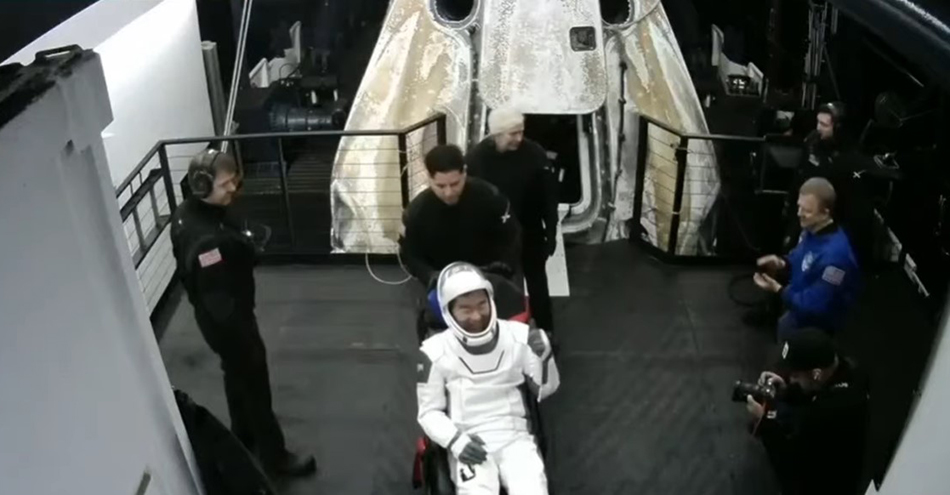

Crew members were brought out on stretchers due to readjustment difficulties after about half a year in space. Japanese astronaut Kimiya Yui exiting the capsule | Photo from the SpaceX broadcast

NASA can’t evacuate just one crew member, because the spacecraft that carries astronauts to the station also serves as the station’s “lifeboat” in an emergency. If only the sick astronaut were sent back to Earth, the other three would be left without an escape vehicle. As a result, the early return has left just three people aboard the ISS—a situation that has not occurred in a long time.

The current station crew, which arrived on a Russian Soyuz spacecraft, includes Russian cosmonauts Sergei Kud-Sverchov – who assumed command from Fincke – and Sergei Mikaev, along with American astronaut Chris Williams. With fewer hands on board, a significant share of the station’s experiments and research is expected to be postponed, both because of the reduced manpower and because the remaining crew will need to spend much more time on routine maintenance – work that, until now, was divided among seven crew members.

The next crew is not due to launch to the station until February 15, assuming no delays. It will include American astronauts Jack Hathaway and Jessica Meir – set for her second visit to the space station – alongside French astronaut Sophie Adenot of the European Space Agency and Russian cosmonaut Andrey Fedyaev.

Highlights of the return and splashdown in a SpaceX video:

Additional content that may interest you

Changes at the Helm of NASA: This Week in Space

The U.S. President reintroduces a previously rejected candidate to head the space agency, a first step toward a private space station, delays aboard China’s space station, and a debate over the expansion of the universe. This Week in Space

calendar 11.11.2025
reading-time 12 minutes

Auroras and Dust on Mars: This Week in Space

Scientists photographed a visible-wavelength Mars aurora for the first time, while another study suggests suspected water flows are likely dust avalanches. Starship faces new issues, and India lost a satellite. This Week in Space

calendar 25.5.2025
reading-time 5 minutes

Staying at the Station: This Week in Space

Another delay in returning the astronauts stranded in space, another Chinese space milestone, another Japanese launch failure, more planned lunar landers, and additional complications for SpaceX. This Week in Space

calendar 26.12.2024
reading-time 8 minutes