Did a Drying Climate Doom the Hobbits?
The small-bodied ancient humans nicknamed “hobbits” lived on the island of Flores until they disappeared around 50,000 years ago. A new study points to a possible cause of their extinction: climate change that reduced rainfall and dried up freshwater sources

23 December 2025
|

8 minutes
|
The ancient humans who lived on the Indonesian island of Flores are an evolutionary puzzle—or perhaps a whole set of evolutionary puzzles.
The first fossils of this species were found in 2003 in a cave called Liang Bua, and it was immediately clear that something about them was unusual: they were far too small. The sediment layer in which they were found indicated they lived only tens of thousands of years ago—a period when other hominins in the region typically fell within, or close to, the body-size range of modern humans, even if often somewhat shorter. Yet the skull that was recovered was exceptionally small. Some researchers initially suggested the remains might represent an individual with a developmental disorder rather than a distinct population.
Later discoveries made it clear this was not a pathology, but a population of small-bodied hominids, just over a meter tall. They were named Homo floresiensis—“the human from Flores”—though they are more commonly known by the unofficial nickname “hobbits,” after the small people in Tolkien’s books.
Bones and stone tools attributed to the hobbits suggest they lived on Flores from at least about 200,000 years ago until around 50,000 years ago. Who were they, and where did they come from? The initial assumption was that they evolved from a population of Homo erectus (H. erectus), a human species that lived in Asia until roughly 100,000 years ago but was much larger than the hobbits. However, a 2017 study comparing hobbit remains with fossils from other hominin species argued that Homo floresiensis shares closer affinities with Homo habilis (H. habilis), a much earlier species that, based on the fossil record, was thought to be confined to Africa. The debate over the hobbits’ origins is still unresolved.
In a recently published study, the researchers shifted focus to the other side of the hobbit mystery: not their origins, but their disappearance. What happened between about 60,000 and 50,000 years ago that led to their loss from the record? Using multiple proxies to reconstruct rainfall on Flores between roughly 90,000 and 50,000 years ago, the team found that a pronounced decline in precipitation preceded the hobbits’ disappearance. They suggest that a prolonged drought may have caused—or at least contributed to—a decline in their population.

Bones and stone tools found on Flores—and attributed to the hobbits (Homo floresiensis)—indicate that they lived there from at least around 200,000 years ago until about 50,000 years ago. The area around the Liang Bua cave, Flores | Garry K Smith
The Stalagmite as a Climate Archive
The researchers analyzed the chemical composition of a stalagmite from a cave near Liang Bua—the site where the hobbit fossils were discovered. The stalagmite grew over tens of thousands of years, spanning the interval before and slightly after the small-bodied hominins disappeared. Because stalagmites form from water dripping off cave ceilings, their layers can preserve a record of rainfall during the period of their formation.
The researchers examined two indicators. The first was the magnesium-to-calcium (Mg/Ca) ratio in the stalagmite. Under wetter conditions, more calcium-rich water reaches the cave and is incorporated into the stalagmites, lowering Mg/Ca. During drier periods, calcium tends to precipitate out upstream—before the water enters the cave—so less calcium is available for deposition and Mg/Ca rises. This relationship can be used to infer changes in annual precipitation.
The second indicator was Oxygen-18 (¹⁸O), a heavier isotope of oxygen. Isotopes are forms of the same element that differ in neutron number: Oxygen-18 has two more neutrons than the more abundant Oxygen-16 (¹⁶O), making it slightly heavier without changing its chemical behavior. Because of this mass difference, during rainfall, water molecules containing ¹⁸O tend to condense and fall from clouds earlier. During intense summer monsoons in Indonesia, much of this ¹⁸O-enriched rain falls over the ocean, so relatively little ¹⁸O reaches the islands—and the cave. Low ¹⁸O values therefore indicate strong monsoon rainfall, whereas higher values indicate a weaker monsoon season.
Using these two indicators, the researchers reconstructed the climate on Flores between about 91,000 and 47,000 years ago and found that this period falls into three clear phases. In the earliest phase, from 91,000 to 77,000 years ago, the climate was very wet. There were no clear seasonal differences, and total rainfall was higher than it is today. From 77,000 to 61,000 years ago, conditions became generally drier, but monsoon rains actually intensified, increasing the difference in precipitation between summer and winter. Finally, from 61,000 to 47,000 years ago, the climate was the driest documented for this region. Monsoon rains weakened, winters did not make up the difference and remained dry, and annual rainfall fell from 1,560 mm in the wettest phase to just 990 mm in the driest years.
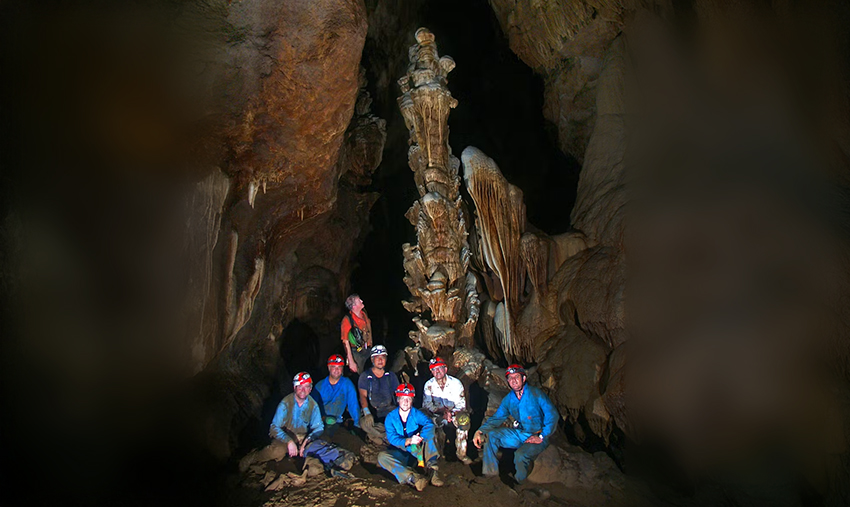
The researchers analyzed the chemical composition of a stalagmite from a cave near Liang Bua, where the hobbit fossils were discovered. The research team in the cave | Garry K Smith
Less Rain, Fewer Elephants — And Fewer Hobbits
The researchers also measured the ratio of Oxygen-18 to Oxygen-16 in the teeth of pygmy elephants that were common on Flores and are thought to have been hunted by the hobbits. Oxygen incorporated into tooth enamel ultimately derives from the animals’ drinking water, and the team found that the isotope ratios in the teeth closely matched those recorded in the stalagmite. By aligning the two records, they were able to date the ancient elephant teeth—and, by extension, the hobbit fossils recovered from the same sediment layers.
The findings showed that roughly 90 percent of the elephant fossils came from the intermediate interval, when strong seasonal rainfall prevailed. This appears to have been the elephants’ preferred climatic regime, and it likely translated into abundant prey for the hobbits. But as conditions shifted and Flores became drier, pygmy elephants declined and eventually disappeared—and the small-bodied hominins vanished from the record as well.
“The ecosystem around Liang Bua became dramatically drier around the time Homo floresiensis vanished,” said Michael Gagan, lead author of the study, in a press release. “Summer rainfall fell and river-beds became seasonally dry, placing stress on both hobbits and their prey.”
The youngest pygmy-elephant fossils found at Liang Bua date to about 57,000 years ago, when seasonal monsoons were at an all-time low. The most recent stone tools attributed to the hobbits are from roughly the same period.
That doesn’t necessarily mean the hobbits went extinct at that point. The researchers suggest they may simply have left—migrating after the animals to another area, for example closer to the coast, where there was still water. If that’s what happened, we still haven’t discovered traces of them in that new location.
That timing doesn’t necessarily mean the hobbits went extinct then. The researchers suggest they may instead have moved elsewhere—following prey and migrating to another area, for example closer to the coast, where water was still available. If so, their traces at that new location have yet to be found.
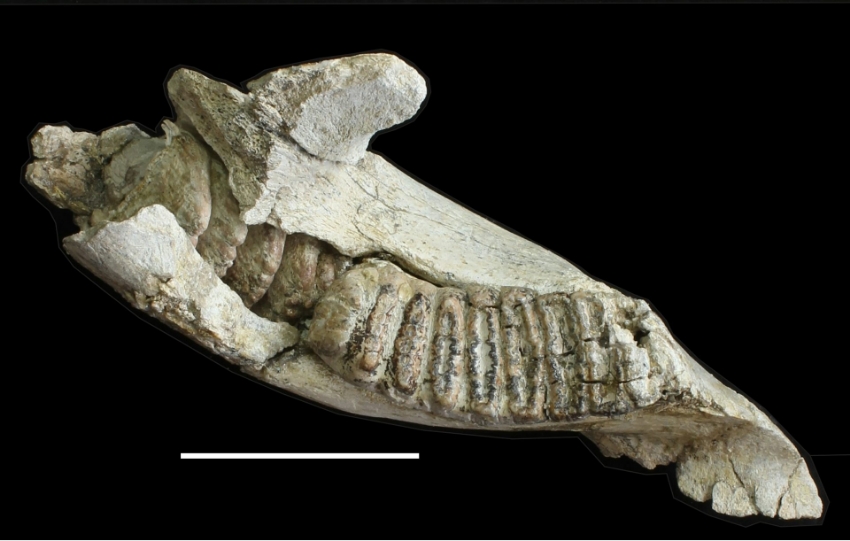
The researchers measured the ratio of Oxygen-18 to Oxygen-16 in the teeth of pygmy elephants that were common on the island and that the hobbits hunted and ate. A pygmy-elephant jaw from the island of Flores | Photo: © Gerrit van den Berg
Did Our Ancestors Encounter the Hobbits?
And what about our own species, Homo sapiens—did our ancestors play a role in the hobbits’ disappearance?
That is another question we still don’t have a clear answer to. Homo sapiens left Africa about 70,000 years ago and spread, among other routes, toward East Asia and Australia. Teeth found on Sumatra, another Indonesian island, indicate that modern humans were already present there more than 60,000 years ago—when the hobbits likely still lived on Flores. On Flores itself, however, no Homo sapiens fossils older than 50,000 years have been found. A meeting between the two species is therefore possible, but we don’t know whether it actually occurred.
“It’s possible that as the hobbits moved in search of water and prey, they encountered modern humans,” said Gagan. If such a meeting occurred, the hobbits may not have been able to compete with their larger relatives. “In that sense, climate change may have set the stage for their final disappearance.”
The study’s findings underscore, once again, how dependent humans—like all animals—are on their environment, and how severe the damage from climate change can be. “The underlying role of freshwater availability in the demise of one of our human cousins reminds us that humanity’s history is a fragile experiment in survival,” Gagan and his colleagues wrote in an article published on The Conversation, “and how shifting rainfall patterns can have profound impacts.”