Israeli Startups and No Room to Dock: This Week in Space
The Israeli startup accelerator in Mitzpe Ramon launches its third cohort; the ISS faces new concerns after damage at a Russian launch pad, yet all docking ports are fully occupied; and China moves closer to reusable-rocket success. This Week in Space.
Taking off with NVIDIA from Mitzpe Ramon
Israeli company Creation Space has opened registration for the third cohort of its EXPAND acceleration program, which supports startups developing dual-use technologies for Earth and space. This cohort, launched in partnership with NVIDIA, will focus on AI, robotics, and autonomous systems. Companies selected for the three-month program will receive end-to-end product support from the idea stage, including development guidance and help with investor fundraising, led by Creation Space experts. This time, participants will also receive mentoring from NVIDIA Inception, access to developer forums, and support in leveraging other NVIDIA technologies.
The first EXPAND cohort began in 2024 and included five companies. The second cohort launched earlier this year with ten companies and the option to receive up to $250,000 for a project. In the third cohort, funding increases: each company may be eligible for grants of up to $300,000 from the U.S.-based investment fund CreationsVC, provided as matching funding if the startup manages to raise an additional $350,000 independently.
“Artificial intelligence is already an integral part of space missions and satellites, but there’s room for much more innovation and breakthrough progress in the field,” said Eran Rosenberg of NVIDIA Inception. “We’re happy to collaborate with Creation Space to expand NVIDIA’s startup community in Israel, and to help entrepreneurs leverage our AI technologies to create impact both on Earth and in space.”
Creation Space operates in Mitzpe Ramon and is advancing plans for an extreme-environments space campus – national infrastructure that will include robotics, simulation, agritech, and space-access capabilities, and serve as a multidisciplinary development hub for startups in these fields. As part of the campus, a robotics and simulation lab is being established, including desert test sites that will allow startups to develop and validate technologies quickly, efficiently, and at lower cost.
“At the heart of our vision for Mitzpe Ramon as Israel’s space city is a simple idea: technologies born on Earth will enable economic prosperity in space, and vice versa,” said Dr. Roee Naor, CEO and co-founder of Creation Space. “We identify space challenges that already have active development budgets, and build companies around them with dual-value solutions – ones that can serve the emerging space market in the foreseeable future, while also delivering value to terrestrial markets today. Likewise, startups that arrive with ‘Earth-based’ solutions gain access to space-sector funding that can accelerate their path into the domestic market. This approach enables faster, safer, and more cost-effective technology development, while strengthening economic growth in the Negev and Israel’s position in the expanding space economy.”
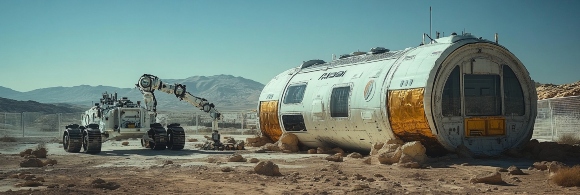
A robotics lab with desert test compounds designed to make technology testing easy. Rendering of a test site in Mitzpe Ramon | Illustration: Creation Space
Station at Risk?
A crewed Soyuz spacecraft arrived at the International Space Station on November 27 carrying three crew members from Russia and the United States. Shortly afterward, it emerged that the launch caused severe damage to the launch pad at Russia’s space center in Kazakhstan. One of the service platforms used to prepare the rocket and spacecraft came loose from its restraints and fell into the “pit”—a lined trench designed to absorb much of the rocket’s exhaust during liftoff. Unofficial reports in Russia said the facility sustained heavy damage and could be out of service for an extended period. Russia’s space agency, Roscosmos, confirmed the damage in a brief statement, adding a vague assurance that “all the spare parts needed for the repair are available to us, and the damage will be handled in the near future.” The Russian newspaper Kommersant, citing sources in the country’s space sector, reported that repairs could take anywhere from six months to a year.
Until repairs are completed, Russia will be unable to launch crew and cargo to the ISS. That gap could be filled by private American spacecraft—most notably SpaceX vehicles, which have been flying astronauts to the station since 2021. The broader concern stems from another critical role played by Russia’s Progress cargo ships: when docked, they periodically boost and adjust the station’s orbit using their engines, preventing the ISS from losing altitude and enabling evasive maneuvers in case of a potential collision with space debris or another object. The station does have its own emergency propulsion system, but only Progress spacecraft can deliver the fuel it requires.
American spacecraft have recently carried out initial tests of boosting the station in place of Russian vehicles, so if Russia’s launch capability is disrupted for an extended period, that option may be explored further. Either way, the incident highlights the importance of building redundancy into launch and resupply systems—and of adopting standardized docking interfaces across spacecraft and stations. That will matter even more as the current ISS approaches retirement near the end of the decade and more private and commercial stations begin operating in low Earth orbit.
Repairs may take months. The Soyuz launch late last weekend and the resulting launch-pad damage:
All Spots Are Taken
Despite the challenges ahead, the space station marked a historic milestone on December 1st: for the first time in its history, all eight of its docking ports are occupied by spacecraft. The record was set after a Soyuz spacecraft carrying a new crew docked, followed by the arrival of the uncrewed American resupply vehicle Cygnus XL, which returned to the station after temporarily undocking for a series of on-orbit tests.
At the moment, two crewed Soyuz spacecraft are docked to the station, along with two Russian Progress cargo vehicles, one crewed Dragon and one cargo Dragon, Cygnus; and Japan’s HTV resupply spacecraft. One port freed up on December 8, when three crew members who had been aboard since April returned to Earth aboard a Russian Soyuz, landing in Kazakhstan early on December 9.
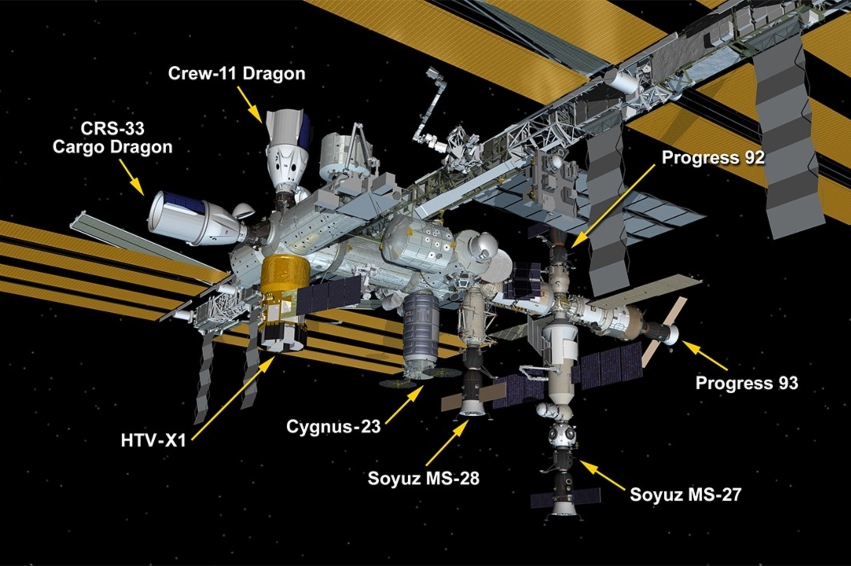
Even in space, parking is in short supply. The International Space Station with eight spacecraft docked | Source: NASA
A Thunderous Landing
The Chinese company LandSpace launched its Zhuque-3 rocket for the first time on December 3, 2025, from the Jiuquan spaceport in northwestern China. Its first stage is intended to be reusable, similar to SpaceX’s Falcon 9. The Chinese rocket—whose design in many ways strongly resembles both Falcon 9 and Starship—successfully ignited its second stage and reached the planned orbit around Earth. The first stage then returned in free fall for a controlled landing about 400 kilometers from the launch site. However, during the engine relight for landing, an explosion occurred, and the flame-wreathed booster slammed into the landing zone at supersonic speed and detonated.
LandSpace stressed that no one was injured and described the attempt as a success: the rocket reached orbit on its maiden flight, and the booster performed as intended until the final moments, making it all the way to the landing site. First flights of new rockets rarely deliver a clean sweep, and partial successes on maiden test flights are far more common than a flawless debut.
Reusable launch vehicles are central to China’s effort to compete with SpaceX—both in the commercial launch market and in building massive communications constellations akin to Starlink. China is currently working on two such networks, each expected to comprise thousands of satellites. Several reusable-rocket tests are planned in the coming months; one of the next vehicles expected to fly is the Long March 12, developed by the Shanghai Academy of Spaceflight Technology, a state-backed organization. Long March 12 is broadly comparable in size and capability to Zhuque-3, with both designed to deliver a payload of roughly 12 tons to low Earth orbit.
Landing in a fireball. The crash of Zhuque-3’s first stage:




 9 December 2025
  7 minutes