Wag the Dog: Exploring the Origins of Tail Wagging
We all love the cheerful tail-wagging of our four-legged friends. But why do dogs wag their tails—and why do they do it far more often than their wild relatives?

9 December 2025
|

12 minutes
|
Anyone who has or has ever had a dog knows the joy of coming home to an enthusiastic greeting—complete with licking, jumping, and of course, vigorous tail-wagging. A wagging tail can be cute, amusing, and occasionally even a bit destructive when it knocks over a cup on the table. But what is all this wagging actually for? And why do dogs wag their tails so often, while wolves do it far less?
A dog’s tail movements are primarily a form of communication—both with other dogs and with humans. If you asked an average person what a dog is expressing when it wags its tail, they would likely say the dog is happy or excited. In the case of a dog greeting its owner, that is often true. But tail wags can convey a variety of messages.
In most cases, “a wagging tail is akin to waving a white flag of surrender—that is, ‘I’m happy to see you and present no threat,’” said Nicholas Dodman, an animal behaviorist from Tufts University in the United States, in an interview with Scientific American.
You can better interpret the messages dogs send by paying attention to other characteristics of the tail, Dodman added. A tail held high signals dominance, while a tail held low may indicate submission or lower status. The speed of the wag also matters: a rapid side-to-side motion usually means excitement, whereas a slow wag suggests uncertainty about the situation.
Soft and fuzzy—and surprisingly helpful with air-conditioning costs. The synchronized, steady tail wagging of two excited dogs | Source: ViralHog, via Giphy
Wag to the Right, Wag to the Left
So far, this all sounds perfectly logical. But there’s another aspect of tail wagging that most of us never consider: the direction of the wag. In 2007, researchers discovered that dogs tend to wag their tails predominantly to the right under certain conditions—and to the left under others. The team observed 30 dogs, both male and female, and recorded their reactions to four different stimuli: their owner, a stranger, an unfamiliar dominant dog, and a cat.
When the dogs saw their owner, they wagged their tails vigorously, with a clear bias toward the right. They also wagged more to the right when approached by an unfamiliar person, although the wagging was less energetic. A cat prompted fewer, more hesitant wags, but these, too, skewed to the right. In contrast, when the dogs encountered the unfamiliar dog, their wagging shifted noticeably to the left.
The researchers concluded that dogs wag to the right when they are experiencing positive emotions and feel inclined to approach the person or animal in front of them. When they feel fearful or prefer to keep their distance, the movement shifts to the left.
As in humans, the muscles on each side of a dog’s body are controlled by the opposite hemisphere of the brain: the right hemisphere controls the left side of the body, and the left hemisphere controls the right. This means the left hemisphere is more active when dogs want to approach, while the right hemisphere becomes more active during negative or avoidance-related emotions.

A wet dog demonstrating a rightward tail wag | Source: TTL Deez, Shutterstock
Brain Asymmetry
Five years later, the same researchers published another study – this time examining how dogs reacted when shown videos of a dog wagging its tail either to the right or to the left.
While the dogs watched the videos—featuring either real dogs or dog silhouettes wagging their tails—the researchers monitored their heart rates and recorded their behavior and body language: where they held their tails, how they stood or sat, whether they panted, moved around, barked, or whined, and more. Based on all these indicators, they gave each dog a score reflecting its level of stress or alertness, without knowing which video the dog was viewing at the time.
The findings showed that the dogs’ heart rates increased when they saw dogs wagging their tails to the left, and their alertness levels rose as well. In contrast, these measures did not increase when the dogs in the videos wagged to the right. It appears that the dogs recognized a leftward wag as signaling more negative emotions and interpreted it as a potential threat.
Do dogs intentionally wag to the right or left to convey different messages to other dogs—and perhaps to humans—watching them? Giorgio Vallortigara, who authored both studies, doesn’t think so. In an interview with The New York Times, he explained that the phenomenon can be accounted for by brain mechanisms alone, without requiring deliberate intention: “It’s simply a byproduct of the asymmetry of the brain,” he explained—one that can cause certain emotional responses to be more strongly associated with activation of a particular hemisphere, which in turn influences the direction of the tail’s movement. It seems that dogs have learned to recognize this directionality.
An example of right- and leftward wagging as documented by the researchers:
The Evolution of Wagging
When and how did dogs first begin wagging their tails? Dogs evolved from the gray wolf (Canis lupus), but researchers still debate where and when this occurred. Most estimates suggest that domestication took place between 15,000 and 30,000 years ago, and it is possible that several separate domestication events took place.
Studies have shown that wolves wag their tails far less frequently than dogs do. Even when wolf pups and dog pups were raised identically from birth and exposed to humans in the same way, the dog pups wagged their tails more often toward people. This suggests that, alongside traits such as calmer temperaments and responsiveness to commands, increased tail wagging emerged during domestication. But what drove that change?
In a 2024 paper, researchers from Europe reviewed more than a hundred studies on tail wagging and its evolution. They propose two hypotheses regarding the development of wagging: first, that increased wagging may be a “side effect” of selecting for other traits during domestication; and second, that humans may have intentionally selected dogs that wagged their tails more.
“We may not be able to take a time machine back to the beginning of the dog-human relationship, but we can look at dog behaviour today in tandem with human behaviour to try and understand what that domestication process looked like,” said Taylor Hersh, from Max Planck Institute for Psycholinguistics in the Netherlands, one of the co-authors of the paper, in an interview with The Guardian. “Tail wagging is a very apparent and interesting behaviour to start with.”
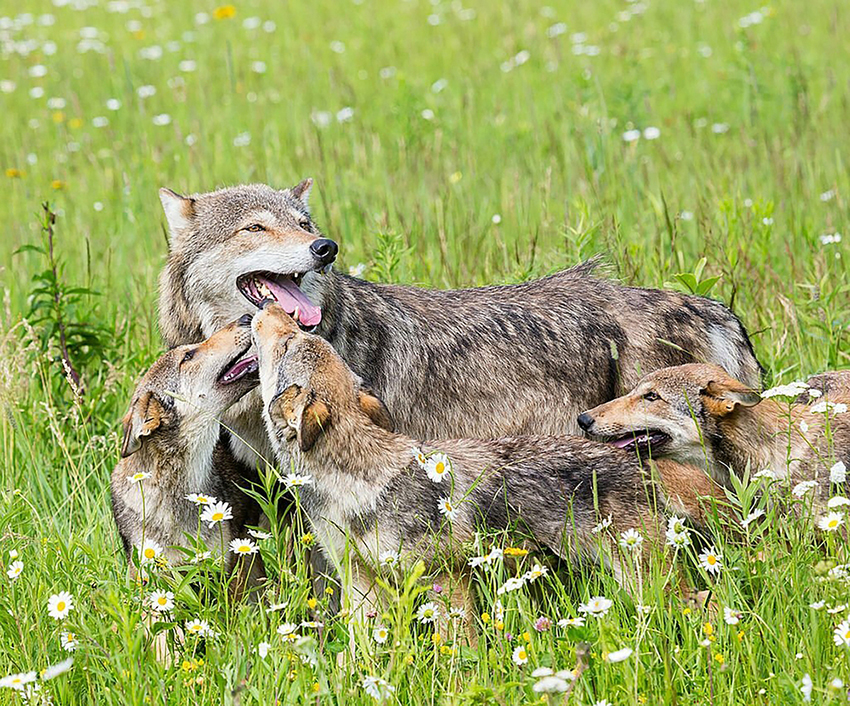
Even wolf pups raised by humans rarely wag their tails—maybe they’re just not that happy to see us? Wolf family | Source: KensCanning, Shutterstock
A Side Effect of Domestication?
The first hypothesis suggests that increased tail wagging in dogs emerged naturally during domestication, without any deliberate intention on the part of early humans. Support for this idea comes from the famous fox domestication experiment conducted in Russia during the last century. In this long-term study – spanning several decades—Dmitry Belyayev and his team worked with silver foxes, a subspecies of the red fox (Vulpes vulpes). Generation after generation, they bred only the most placid individuals: those that tolerated human presence and did not respond with fear or aggression.
“In the first years,” wrote Lyudmila Trut, Belyayev’s research student, in an article for Scientific American, “The vast majority of the foxes seemed less like dogs than like fire-breathing dragons.” Only a few reacted to the presence of humans with something close to indifference, seemingly tolerating but not enjoying it, and these were selected to mate and produce the next generation. In subsequent generations, more and more such foxes appeared, and by the fourth and fifth generations, pups emerged that were happy when humans approached them. By the sixth generation, pups appeared that eagerly sought contact with humans, licked people’s hands, and allowed themselves to be petted and picked up.
There is nothing surprising about this—that is how artificial selection works. If, in each generation, we choose the individuals that exhibit a particular trait, that trait becomes more common in the generations that follow. But the tame and friendly temperament of the domesticated foxes was not the only thing that set them apart from the wild foxes used at the beginning of the experiment. By the sixth generation and beyond, the foxes began to display a variety of traits that had never been intentionally selected for: some developed floppy ears, curly tails, or patchy fur instead of the uniform silver fur color.
These traits, which emerged alongside selection for a calm temperament, are part of what is known as the “domestication syndrome”: a suite of characteristics observed across many domesticated animals, from dogs to pigs, goats, and horses. The syndrome also includes traits that are not anatomical but behavioral and physiological, such as extended breeding seasons and a tendency to exhibit “puppy-like” behaviors even in adulthood.
The prevailing hypothesis is that domestication-syndrome traits evolved due to genetic changes that also produce a calm, non-aggressive, non-fearful temperament. In other words, these traits are byproducts of selecting for sociability and gentleness.
And what about tail wagging? It is not considered part of the domestication syndrome because it does not appear in other domesticated species. Yet Belyayev’s domesticated foxes did wag their tails at humans—something wild foxes do not do. It therefore seems that tail wagging increased among them without any deliberate selection, emerging instead as a by-product of choosing tame foxes. And if this occurred in foxes, it is quite plausible that the same thing happened during the domestication of dogs.
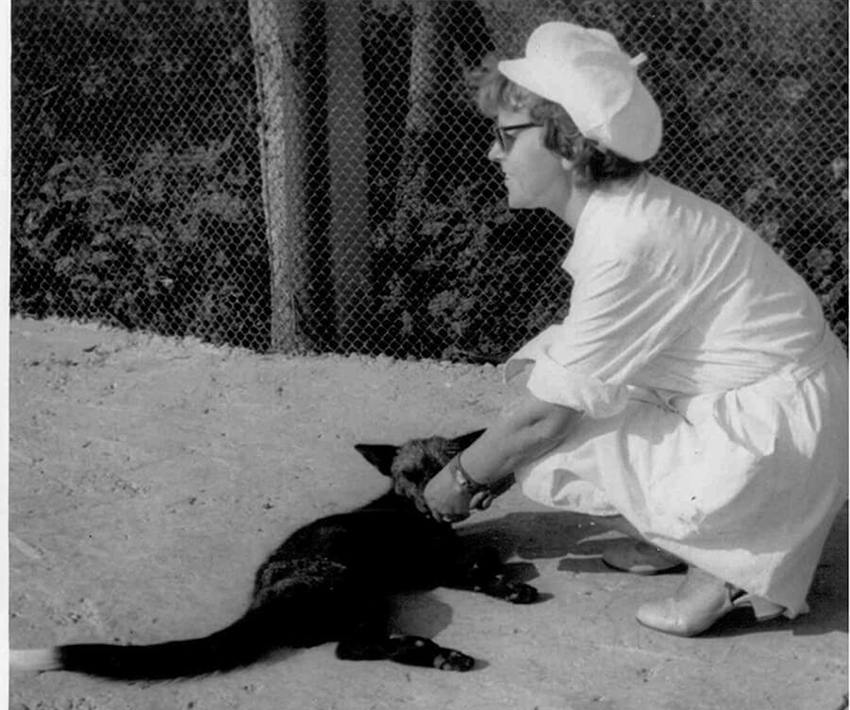
Belyayev’s research student, Lyudmila Trut, petting one of the pups in the study in 1974. Source: Courtesy of Lyudmila Trut and the Institute of Cytology and Genetics.
Wagging to the Beat
The second hypothesis is that humans intentionally favored wolves and early dogs that wagged their tails vigorously. “We put forth a new hypothesis that humans consciously or unconsciously selected for tail wagging during the domestication process because we are very attracted to rhythmic stimuli,” said Silvia Leonetti, who led the study, in an interview with The Guardian.
Humans across cultures enjoy rhythmic music, and studies show that rhythms evoke positive emotions in us. A wagging dog’s tail doesn’t produce an audible beat (usually), but it does move in rhythm—and it’s possible that early humans found this rhythmic motion appealing or calming.
Holly Root-Gutteridge, a dog researcher at the University of Lincoln, who was not involved in the study, told The Guardian that the hypothesis is intriguing, but more evidence is needed to convince her. In her view, humans may have preferred wagging dogs regardless of rhythm simply because wagging is an effective form of communication—quieter than the alternative communication strategy dogs use: barking.
“I suspect ancestral humans saw tail wags as a positive, easy to read sign in wolves, and developed it the way we talk with our hands – as a communicative gesture that we can easily understand.”
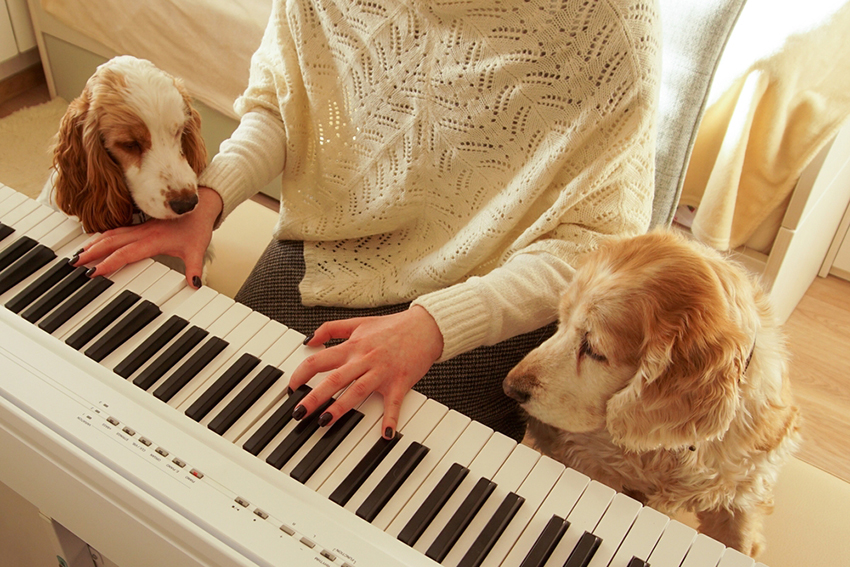
I love the way you move (your tail) 🎶. Two judgment-faced dogs stand beside a woman playing an organ | Source: Pensioner, Shutterstock
More Wagging Than Meets the Eye
Although we all know—and love—dogs’ tail wagging, there is still much we don’t know about this charming trait. “I’d like to understand what happens in the brain, the mechanism behind what we are seeing,” said Andrea Ravignani, the senior researcher behind the paper, in an interview with Science. “We still don’t know exactly which parts of the dog brain control which features of the tail wagging. Is tail wagging for dogs similar to breathing that we can partly control? Or is it similar to blushing? Do rhythmic areas in dog brains activate? I would also want to see whether abstract thinking areas, communication areas, and so on, activate. It’s a whole world of possibilities to explore and understand.”
In recent years, several studies have used functional brain imaging—functional MRI—to investigate dogs’ brains. fMRI not only reveals the brain’s structure but also shows which regions activate in response to different stimuli. The technique is usually used to study humans, not animals, because it requires the subject to lie perfectly still in a small, noisy space while remaining awake—an extremely difficult task for most animals. Recently, however, researchers have managed to train dogs to do exactly that, which may allow them to explore the questions Ravignani raised. So far, though, no functional brain imaging studies in dogs have been published that focus specifically on tail wagging.
Such studies, together with behavioral research on dogs, could help us better understand our furry companions and the bond we share with them—a bond that has lasted for thousands of years. “The three of us and our other co-author are mega–dog lovers,” Hersh told Science. “ I think a lot of the research that we do in general stems from this love of animals and from wanting to understand their communication better.”