The Magic Prompt: How to Get Better, Less Repetitive Answers from AI Chatbots
Do chatbot responses sound familiar and repetitive? A small change in how you phrase your prompts may help you get more out of them.

18 July 2026
| 
8 minutes
When generative AI became widely available in 2022, we were captivated by the rapid pace of innovation and by how much its outputs seemed to improve with each new update. At first, the bots’ strange answers and bizarre creations were mostly amusing. But before long, amusement gave way to concern over factual errors and the ethical questions raised by AI-generated content.
Computer science researchers and engineers are well aware of these problems, and have been developing a range of techniques to improve model outputs. Yet these very solutions may be creating another, equally troubling problem: upgrades meant to improve AI systems can also sharply limit the diversity and creativity of their responses. In trying to ensure rich, high-quality and safe content, models may end up producing answers that are predictable, clichéd and lacking in variety. Researchers describe this as a trade-off between quality and diversity.
Consider the following example. In a course taught by one of us at Western Galilee College, education students were asked to read an article about a study in which teachers identified traits associated with gifted students. The students were then given a task: ask an AI system to suggest one additional trait that was not mentioned in the article. Because the assignment required independent, creative thinking, we expected to see a broad range of original answers. Instead, many of the responses were strikingly similar, even though they came from several different language models, including ChatGPT, Gemini, Claude and others. The same pattern appeared in responses to other questions that called for creative thinking.
Regular users of generative AI often say they can already predict how it will respond. No matter how much we change the wording of our prompts, the hope of receiving a wider range of answers can seem increasingly remote, especially when the question is narrowly focused. Researchers refer to this tendency to converge on a very limited range of answers as “mode collapse.”

Many of the responses were strikingly similar, even though they came from several different language models. A smartphone displaying apps for a range of language models | Shutterstock, PJ McDonnell
Refining the Training Process
The first stage in developing a generative AI model is its initial training. During this stage, the model processes vast amounts of data, identifying patterns that it can later use to generate coherent, consistent content. Early language models, such as GPT-2, released in 2019, relied primarily on this form of training. Their responses were varied, but often inconsistent and error-prone.
One way to improve a model’s output is to add further stages of training. One such method is reinforcement learning from human feedback, or RLHF. After the initial training, human evaluators rank the model’s responses according to their preferences. The process resembles the way people learn when a teacher, instructor or other authority gives them feedback on their work: they draw lessons from that feedback and improve. The key difference is that, in generative AI systems, the feedback is provided by another generative AI model that simulates a human response.
AI companies employ human evaluators, often through outsourcing firms, to rank content generated by their models. These rankings are used to create a dataset that reflects human preferences regarding AI-generated content. This new dataset is used to train a reward model, which is itself a generative AI model. The reward model is subsequently incorporated into the training of the original model, providing a score for each of its outputs. This score estimates how favorably a person would respond to the result. Through repeated cycles of evaluation and adjustment, the reward model guides the generative AI toward producing responses that are more likely to receive high ratings from a human perspective.

AI companies employ people to rank the outputs of content generators, using their assessments to create a dataset of human preferences regarding AI-generated content. A woman completing a survey on a computer | Shutterstock, Andrey_Popov
Mode Collapse
Refining training methods is meant to improve AI models. But could these well-intentioned efforts have the opposite effect, actually contributing to their decline? Mode collapse—the tendency of models to converge on a narrow, fixed range of outputs—has been linked, among other things, to repeated cycles of feedback and adjustment. The phenomenon was first described in relation to early image generators known as GANs (Generative Adversarial Networks), which were developed in 2014.
These early image-generation models were built as a loop involving two systems: a generator and a discriminator. The generator is trained to create images—for example, convincing images of human faces—while the discriminator is trained to distinguish real images from those produced by the generator. The generator tries to fool the discriminator, and the discriminator tries to catch the generator. As this competition progresses, the generator’s outputs become increasingly similar to real, convincing images.
Researchers found that, in this kind of process, the generator may converge on one particular style of content while avoiding others. It settles into a safe zone, giving up the improvements that can come from producing a wider range of content. As a result, its ability to generate varied outputs is impaired. A rough human analogy would be an artist who begins as a free and experimental creator but receives praise mainly for one type of work. If the artist lacks confidence, they may restrict their own creativity and produce only the kind of work that has already won recognition, fearing that any departure from it will not receive the desired reward.
Several recent studies suggest that even the newest generators—the systems behind today’s popular chatbots—may be at risk of mode collapse as a result of feedback-based training. Reinforcement learning from human feedback may actually steer a model toward a narrower range of content. Some researchers attribute this to the way models weigh feedback: when especially rare votes are excluded from the calculations, the process gradually pushes the generator toward increasingly uniform content that receives “the majority of the votes.”
A team of researchers from Stanford University, Northeastern University and West Virginia University offers a simpler explanation. They argue that one of the main drivers of mode collapse is the lack of diversity in the human feedback itself. In other words, part of the problem may lie with the people who rank the responses.
From a psychological perspective, people often prefer familiar content. They tend to give higher ratings to material that is common, recognizable and easy to process, treating it as a more successful output. This preference has a strong influence on the training data and can also contribute to other undesirable effects, including the introduction of social biases into training datasets. As a result, creative and unconventional outputs are pushed toward the bottom of chatbots’ response preferences and are retrieved only rarely.
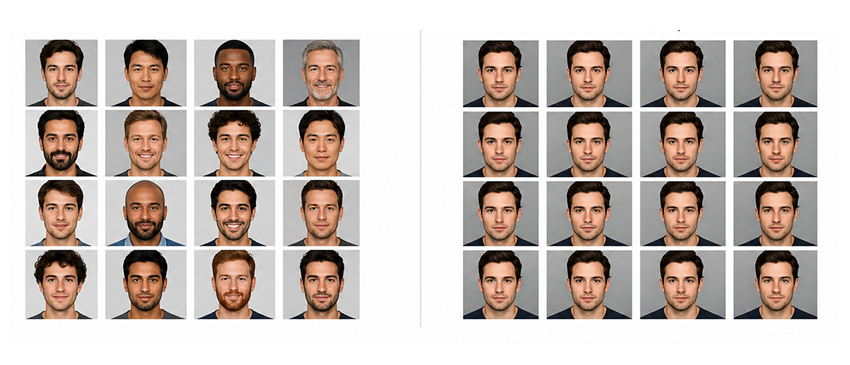
Early models tended to converge on a particular style of content while avoiding others. Images of faces generated using unstable training, as in an early model (right), and using a more sophisticated training process | Liat Peli using ChatGPT
Restoring Diversity
To elicit a more diverse range of content, researchers propose a simple prompting technique called verbalized sampling. The idea is to ask the model explicitly to generate several possible responses and provide an estimated probability for each one. Text generators build their output step by step, choosing at each stage from a range of possible continuations, each with a probability based on the text that came before it.
Every possible output from a text generator therefore has a probability assigned to it, as do the alternative outputs the model could have produced. The model is unlikely to reveal the exact probabilities calculated during generation. Even so, explicitly asking it to produce responses with different estimated probabilities appears to encourage a wider range of answers. Experiments show that this method can significantly increase the creativity and diversity of model responses without compromising accuracy or safety, and that it works especially well with the most advanced models currently available.
Suppose we want a chatbot to tell us a joke about an elephant or a story about a tiger. We can begin the prompt with a simple instruction: “Generate five different responses to the following request, and give the probability of each one.” That is all.
According to the researchers, a prompt such as “Generate five responses to the following request, and give the probability of each one: Tell me a joke about an elephant” will produce more varied responses than a narrowly phrased request such as “Tell me a joke about an elephant.” It may even work better than simply asking for a list of answers, such as “Tell me five jokes about an elephant.”
The reason is that this wording—the “magic prompt”—encourages the chatbot to draw on outputs closer to the edges of its range of possibilities. Alongside conventional responses, it therefore produces more creative ones.
The researchers also tested another option: explicitly asking the chatbot to generate responses from the tail of its probability distribution. This approach, however, can create the opposite problem: too many unlikely or fringe responses. In such cases, a better prompt might be: “Generate five responses to this question and show the probability of each one. One response should come from the tail of your probability distribution.”
This method belongs to a broader family of prompting techniques—ways of phrasing a request so that a chatbot is encouraged to produce content outside its usual response patterns. Many of these techniques are designed to bypass a language model’s safety mechanisms, but they can also be used to elicit answers that are more varied and of higher quality.
Such tricks will not prevent models from becoming less diverse over time; developers will need to address that problem in other ways. For users, however, they may offer a back door to getting a little more out of the models.
A Solution to Every Problem?
So should we start adding this sentence to every conversation we have with a chatbot? Not necessarily. The “magic prompt” is mainly useful when we want to avoid clichéd responses and generate more creative text.
AI companies may also integrate verbalized sampling directly into products such as ChatGPT, Gemini and Claude, as a built-in feature that is activated when a task calls for greater variety—if they have not already done so.
And given the rapid pace of development in artificial intelligence, as well as the especially fluid and fast-changing nature of prompt engineering, this particular “magic prompt” may already be replaced by another technique by the time this article is published.
Even so, the “magic prompt” offers a revealing glimpse into the complex relationship between humans and artificial intelligence. It also raises questions about the ambition to make AI more human—but not too human.