


 6 March 2025
  6 minutes
 Tears of joy stream from our eyes when we are overwhelmed by feelings of happiness, elation, or gratitude. Although crying is typically associated with distress, intensely positive experiences—such as receiving an award, a marriage proposal, or watching an emotional film—can also bring people to tears. In other words, crying occurs when we become emotionally overwhelmed and exceed our capacity to contain those feelings, even if they are positive.
Tears are the most defining feature of crying. Our eyes continuously produce tears to protect the eye’s surface from foreign particles—these are called basal tears, which drain into the nose without spilling from the eye. The increased production of tears as an emotional expression is considered unique to humans. However, a recent study measuring an increase in tear secretion in dogs upon reuniting with their owners (compared to meeting another familiar person) challenges this assumption. Additionally, crying is not just about tears; it also involves sobbing sounds and breathing spasms, which are observed in some animals as well. Nevertheless, at least among humans, crying is a universal experience—one that has led many researchers to ask: Why do we cry from happiness?
Crying is beneficial to us because it promotes emotional and physical relief. Our body constantly strives to return to baseline levels across physiological and emotional parameters. Strong emotions—especially intense positive ones that bring us to tears—can disrupt this balance by increasing heart rate, blood pressure, and respiratory rate. This heightened physiological arousal is regulated by the autonomic nervous system, which consists of two opposing subsystems: the sympathetic and parasympathetic nervous systems. The sympathetic nervous system is active in emergency situations, keeping us alert and preparing us for action. During its activation, heart rate increases, blood pressure rises, and breathing becomes rapid and shallow. In contrast, the parasympathetic nervous system is active during rest and relaxation.
Studies have shown an increase in sympathetic activity—such as a rise in heart rate and skin conductance—prior to crying. However, the most crucial finding is that after crying, the balance between sympathetic and parasympathetic activity returns to baseline levels. This suggests that crying is one of the mechanisms through which the parasympathetic nervous system suppresses sympathetic activity, restoring physiological balance.
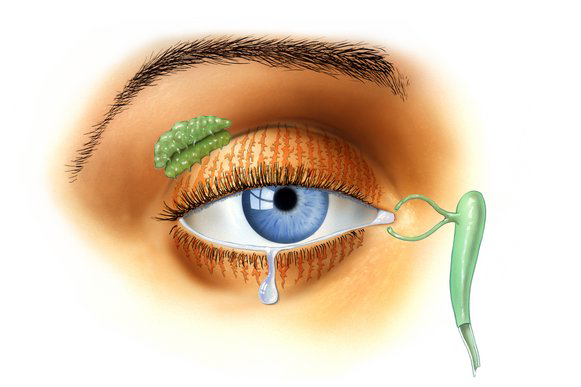
Tears are produced in the gland located above the eyelid on the left side of the illustration and continuously drain into the nose via the ducts on the right. Increased tear production as an expression of emotion is a nearly universal and uniquely (almost) human phenomenon. | Illustration: BO VEISLAND / SCIENCE PHOTO LIBRARY
A Surge of Relief
The brain region responsible for emotional expressions such as crying is located in the brainstem and is called the periaqueductal gray (PAG). The cells in the PAG receive input from our emotional system (the limbic system) and then execute a motor program to express emotions, such as laughter or joyful crying. Each component of crying—whether it’s the sounds produced, muscle contractions, breathing spasms, or tears—may contribute to relief in different ways. For instance, let’s examine how the body regains balance through tears.
When we cry from happiness, tears are produced by the lacrimal glands, located near the eye sockets. These glands are controlled by nerve endings that either stimulate or inhibit their activity. The nerves regulating tear production belong to both the sympathetic and parasympathetic nervous systems. However, it is specifically the parasympathetic nervous system, associated with relaxation, that stimulates tear production, whereas the sympathetic nervous system suppresses it. In other words, the parasympathetic system encourages tear production to counteract the heightened arousal previously induced by sympathetic activity.
Among other effects, parasympathetic activity triggers the release of acetylcholine in the lacrimal gland, which facilitates the secretion of various tear components. The composition of emotionally induced tears differs from that of basal tears, which are continuously secreted to protect the eyes. Emotional tears contain electrolytes and various proteins, including hormones and other substances that influence mood. This suggests that tears help release certain chemicals as part of an emotional discharge on a physiological level.
One key substance found in high concentrations in emotional tears is cortisol, a hormone associated with stress. This led researchers to hypothesize that crying removes excess cortisol from the body. To test this, a study had women watch an emotionally moving film, designed to bring them to tears. Cortisol levels in their blood were measured before and after the screening. The results showed that women who cried during the film had lower cortisol levels afterward compared to those who did not cry. The conclusion was that crying helps reduce stress and restore physiological balance.
Additional hypotheses suggest that crying involves other factors that positively impact mood. One such factor is oxytocin, commonly known as the “love hormone”, which is generally associated with relaxation and lower cortisol levels. Most research highlights oxytocin’s role in responding to another person’s crying, particularly in the context of parental care, but only a few studies have directly examined its connection to self-crying. However, oxytocin is known to be involved in parasympathetic activity, and a recent study in dogs suggested that oxytocin enhances tear production.
Additionally, studies indicate that both crying and laughter trigger the release of endorphins, natural chemicals in the brain that promote a feeling of euphoria.

Emotional tears contain substances that influence mood and contribute to emotional release on a physiological level. A man crying in front of a computer screen. | Illustrative photo: Khosro, Shutterstock
What’s in Tears?
It turns out that the substances found in tears may not only affect us but also influence those around us. In a study led by Prof. Noam Sobel from the Weizmann Institute of Science, researchers collected tears produced by women crying from sadness and examined their composition and their effects on men. They discovered that tears triggered by sadness reduced sexual desire and testosterone levels in men. This suggests that there may be a chemical difference between tears of sadness and tears of joy. Indeed, a recent study found that there are distinct differences in the composition of basal tears, tears of sadness, and tears of joy. This may be part of the mechanism by which tears serve as a means of nonverbal communication between people.
The findings regarding the chemical composition of tears align with psychological research showing that crying also functions as a social signal—helping to elicit support from others and to foster empathy and closeness. Additional studies support this notion, indicating that people tend to cry more in the presence of others than when they are alone.
A small study measuring brain activity in humans during the buildup and release of tears sheds light on the synchronization between the central nervous system and the autonomic nervous system. Researchers from Japan used near-infrared spectroscopy, a technique that measures changes in blood oxygen levels—an indirect measure of brain activity, as active neurons consume more oxygen.
Eight participants watched an emotionally moving film designed to bring them to tears. During the viewing, the researchers measured oxygen levels in their brains. Before crying began, there was a gradual increase in activity in the medial prefrontal cortex (mPFC), a brain region associated with emotional regulation. At the same time, an increase in heart rate was observed, reflecting emotional intensity and sympathetic nervous system activity.
At the moment crying started, there was a sharp rise in medial prefrontal cortex activity, which researchers interpret as the shift from sympathetic to parasympathetic dominance. After crying, participants who shed tears reported a greater sense of mental clarity compared to those who did not cry—further supporting the idea that crying activates the parasympathetic nervous system, helping to restore emotional balance.
Ultimately, tears of joy are the body’s way of coping with overwhelming emotional waves and regulating them in a manner that promotes mental well-being. So, the next time you feel tears welling up, let them flow—your body knows what it’s doing.